
JUL 31, 2026 · Padres
Padres
Record Sale, No Championship Formula
José E. Feliciano and Kwanza Jones paid a record $3.9bn for a club drawing 42,000 a game, ranked last in farm talent, and carrying $858m owed to five underperforming stars.
By Kyle McAuliffe · · 5 min
The most expensive baseball team ever sold has the emptiest farm system in the sport, $858m owed to five players, and no regional television network.
José E. Feliciano and Kwanza Jones agreed in May 2026 to pay $3.9bn for the San Diego Padres—a 26% premium to Forbes' $3.1bn March valuation, which was based on estimated revenue of $484m and operating income of roughly $20m. The arithmetic is eight times revenue for a club in the 30th-largest media market in the United States. The Dodgers are the immediate obstacle and cannot be outspent: back-to-back champions, roughly twice San Diego's revenue, thirteen games clear in the division. Milwaukee is the more instructive comparison—67-40 this season on a $124m Opening Day payroll, built almost entirely through internal development. San Diego has spent five years trying to beat Los Angeles at its own game on a fifth of its local media revenue, while running Milwaukee's problem in reverse. The championship-asset index is editorial, not a model. It scores five dimensions on a 0-100 scale to make the shape of the gap legible; the inputs are valuation, tax payroll, share of value from controlled players, published farm rankings, and postseason results since 2020.
$3.9bn
Record baseball sale price — 26% premium to Forbes' $3.1bn March valuation on $484m revenue
5.6 wins
Michael King and Mason Miller combined — cost $21m while five stars owed $858m produced 4.5
30th
Farm system rank of 30 clubs — emptied by trading Leo De Vries for Mason Miller in July 2025
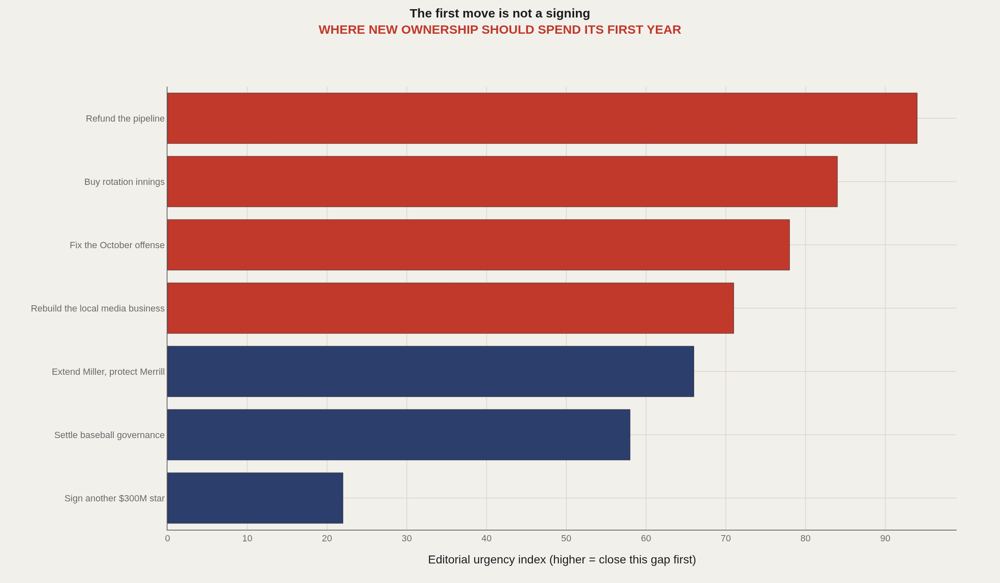
The memo: six moves, in order
The instinct at this price will be a statement signing. It is the wrong first move: the roster's marginal need is not another $300m bat. In rough order of urgency: 1. Refund the pipeline as a capital project, not a scouting line. Spend the full draft and international bonus pools, buy development infrastructure, and hire away the staff that rival clubs use to turn marginal prospects into major leaguers. It is the cheapest source of wins in the sport and the only one that compounds. It is also the item the outgoing regime spent. 2. Buy innings, not headliners. The rotation has been carried by King through a summer in which the salary sitting on the injured list has been the ninth-largest in baseball. October is decided by a club's fourth and fifth-best pitchers, which is the category San Diego has never bought and the one available cheaply every winter. 3. Fix the October offense deliberately. The last two eliminations were failures to score: shut out over the final two games of the 2024 division series, five runs across three games in 2025. This lineup is built on power and aggression, a profile that fails against elite pitching in short series. On-base skill and contact are the missing inputs, and they cost less than power does. 4. Treat local media as a business you own. Seventy thousand direct subscribers is the biggest such base in baseball and it was assembled in three seasons out of a bankruptcy. Own the funnel, price it properly, and extend it across the border rather than waiting for a regional network that is not coming back. 5. Extend Miller; treat Merrill as untouchable. Both are cheap, both are in their twenties, and neither can be replaced from within this system. Buying out Miller's arbitration years fixes a cost curve for four seasons; trading him fixes a quarter. 6. Settle governance before the winter. Feliciano will be the control person and intends to run the club in partnership with Jones. The most valuable document they can produce internally is the mandate: one decision-maker for baseball, one time horizon, one definition of success. The Seidler era's strength was clarity of purpose; its weakness was that the purpose outlived the plan for achieving it.
The arithmetic of a first title
San Diego does not have a 90-win problem. It reached the postseason five times from 2020 through 2026, including a wild-card sweep of the Cubs, and left without a pennant every time. The 2026 exit was a division-series loss to the Brewers.
Closing that gap is not a payroll exercise, which is fortunate, because payroll is the one lever this club has already pulled to its limit. It is a depth-and-pipeline exercise, and those are the two things a recapitalized franchise can buy quickly—if the owners spend on infrastructure rather than announcements.
■ END
The Fine PrintBack of the BoxEnd Credits
NoteWarningsDisclaimer
Artometrics data brief. Figures come from the sources below. Derived shares and editorial indices are not audited financials.
SourcesContentsSources
- SourceBaseball Reference. 2026 San Diego Padres Statistics. baseball-reference.com
- SourceForbes. (2026, March). Baseball's Most Valuable Teams. forbes.com/mlb-valuations
- SourceMajor League Baseball. Commissioner remarks on Padres sale documentation, July 14, 2026. mlb.com
- SourceSportico. (2026). San Diego Padres Sale: Feliciano, Jones to Pay MLB-Record $3.9 Billion. sportico.com
- SourceSports Business Journal. (2026, July). Feliciano group submits final documentation for Padres sale. sportsbusinessjournal.com
- SourceSan Diego Union-Tribune. (2026, July). Padres farm-system and trade-deadline coverage. sandiegouniontribune.com
- SourceBaseball America. (2026, July). MLB Farm System Midseason Talent Rankings. baseballamerica.com
- SourceRelated Artometrics report: The Most Expensive Team That Has Never Won Anything
- SourceRelated Artometrics report: Dodgers
- SourceRelated Artometrics report: Sports Dynasty Index
- ReportFull report: artometrics.com/blueprint
MethodAssemblyMethod
Numbers in this issue are the published figures. The skin changes type, rules, and chart color only.
PlatesMade byImage credits
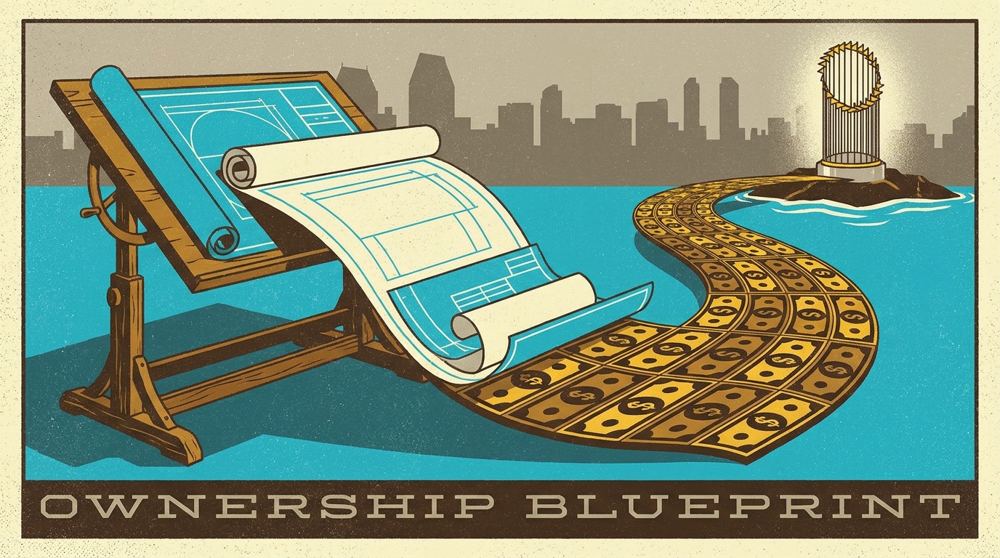
- HeroArtometrics Padres illustration.
- PlatePortrait of Luca Pacioli, attributed to Jacopo de' Barbari, c. 1495. Public domain, via Wikimedia Commons.
- PlateColor print of a toy shop, Utagawa Sadahide, 1860. The Metropolitan Museum of Art, CC0, via Wikimedia Commons.
- PlateBelasco Theatre box office, published November 1907 in Architects' and Builders' Magazine. Unknown photographer. Public domain, via Wikimedia Commons.


Updated through JUL 31, 2026.