
JUN 15, 2026 · United Nations
United Nations
Brazil Dominates the UN Roll-Call in a 100,000-Vote Sample
In a 100,000-row UN voting extract, Brazil appears 747 times and 79,663 votes (80%) are affirmative — before ideological coalition modeling begins.
By Kyle McAuliffe · · 5 min

In a 100,000-record extract of United Nations roll-call votes, 79,663 positions (80%) are affirmative, Brazil appears 747 times as the most recurring member state, and most country entities appear only once. The dataset is categorical — no numeric scores — making it a recurrence and frequency archive rather than a win-rate leaderboard.
79,663
Affirmative votes in the sample — 80% of all recorded positions concentrate in the yes category
747
Brazil appearances — the most recurring country name before any entity or name-variant cleaning
Long tail
Most country entities appear once, warning against over-reading sparse-observation states
Yes votes dominate the sampled UN record
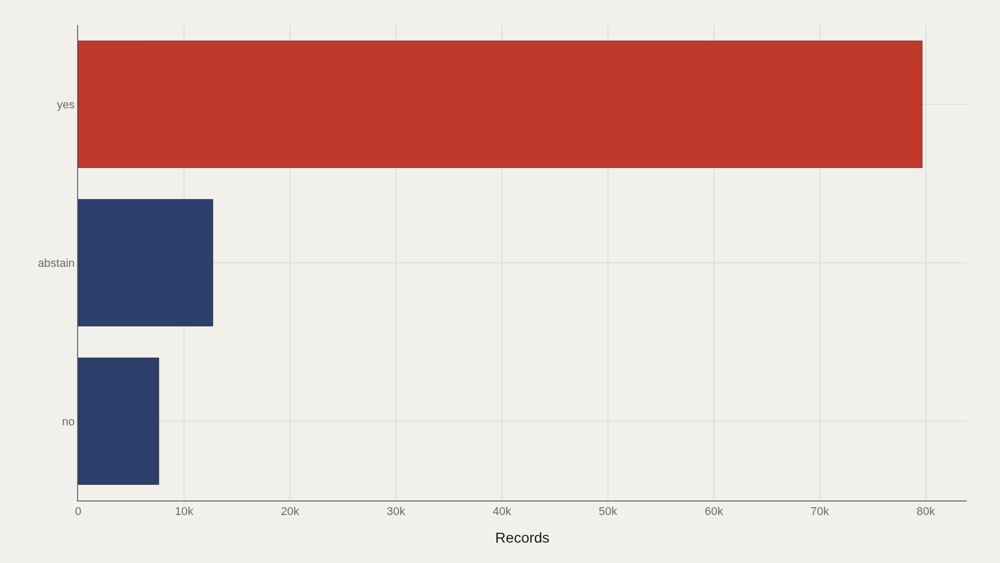
Yes dominates with 79,663 records. In a 100,000-row extract, that is the center of gravity: 80% of recorded positions in this slice are affirmative. Abstain and no exist, but they do not match yes for volume. Dominance here is a frequency fact, not proof that the General Assembly always agrees. It shows where the mass of the table sits before any conflict analysis begins. The United Nations General Assembly often votes on resolutions that have already passed through committees, negotiations, amendments, and diplomatic bargaining. A large yes category can therefore reflect agenda-setting and consensus-building before the roll call, not an absence of disagreement in world politics. The public vote is the final visible record of a process that began earlier. UN voting scholars usually move beyond raw categories into ideal-point models, affinity scores, or issue-area subsets because the meaning of a yes vote depends on the resolution. A yes on decolonization, a yes on nuclear disarmament, and a yes on a budgetary item are all affirmative votes, but they do not carry the same geopolitical signal.
Brazil appears most often among country names
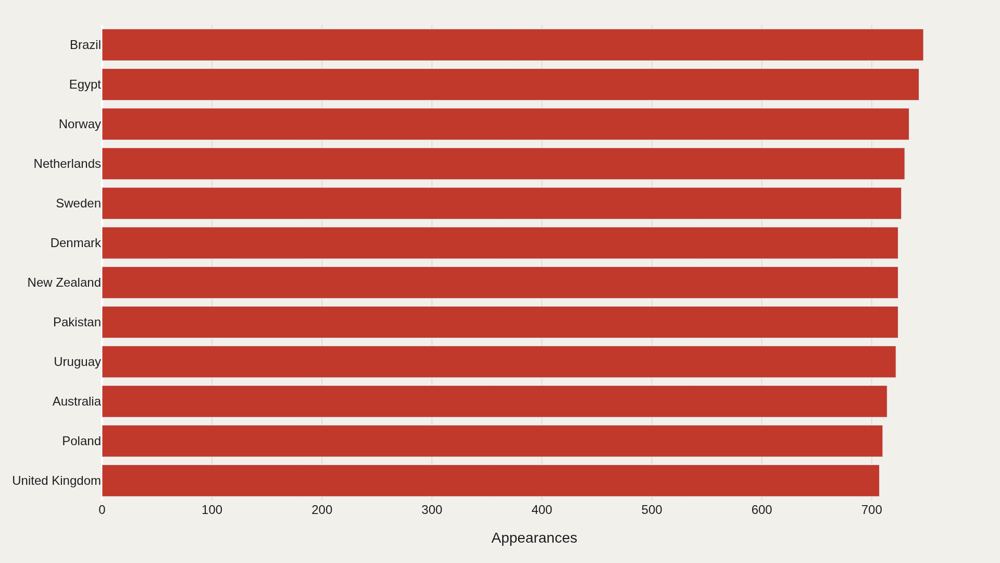
Brazil appears 747 times — the most recurring country name in the file. The top dozen countries account for a visible share of all 100,000 rows, which is what a recurring-member chart shows: who is densely present in the extract. High appearance counts can reflect coverage, membership longevity, or how the sample was built. They are presence metrics, not win rates. Brazil has been a United Nations member since 1945 and is a frequent actor in General Assembly voting records. The country's foreign-policy tradition includes visible positions on development, non-intervention, South-South cooperation, and Security Council reform. But the 747 appearances shown here are a row-count fact, not a claim that Brazil is uniquely influential in every issue area. Country recurrence is also shaped by institutional continuity. Newer UN members, dissolved states, renamed states, and countries with interrupted or transformed membership histories appear differently from long-standing members. The Soviet Union/Russia, Yugoslavia/successor states, Czechoslovakia/Czechia and Slovakia, and country-name standardization issues are why entity handling matters in UN vote data.
Vote categories restate the file's center of gravity
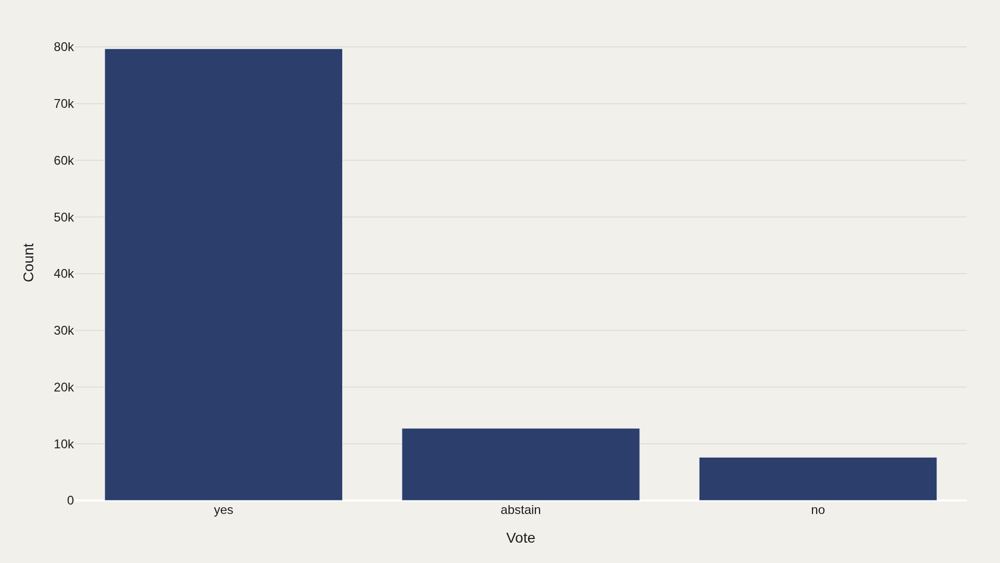
Yes is again the largest bucket with 79,663 records when vote categories are plotted as a bar landscape. Repeating the category cut confirms that the headline frequency is not an artifact of a single chart type. Category concentration shows where editorial attention should start — with the yes majority — while still leaving room to inspect the smaller no and abstain bands. Abstentions deserve caution because they can mean several things: neutrality, strategic ambiguity, alliance pressure, domestic constraint, protest against wording, or unwillingness to oppose a popular resolution directly. In Cold War voting studies, abstention is often treated as analytically distinct from both yes and no because it can carry diplomatic information without joining either pole. No votes are smaller in this extract, but they are often more diagnostic. A rare no can identify a strongly contested resolution, a bloc split, or a state protecting a core interest. The category chart gives the denominator; substantive research still needs resolution identifiers and issue tags to interpret the minority categories.
What to take away
In this extract, yes is the majority language of recorded votes (79,663 of 100,000), Brazil is the most recurring country name (747 appearances), and BR leads among country codes.
■ END
The Fine PrintBack of the BoxEnd Credits
NoteWarningsDisclaimer
Artometrics data brief. Figures come from the sources below. Derived shares and editorial indices are not audited financials.
SourcesContentsSources
- SourceData Science Learning Community. (2021). TidyTuesday: UN Votes. https://raw.githubusercontent.com/rfordatascience/tidytuesday/main/data/2021/2021-03-23/unvotes.csv
- SourceData Science Learning Community. (2021). TidyTuesday UN Votes source folder. https://github.com/rfordatascience/tidytuesday/tree/main/data/2021/2021-03-23
- SourceErik Voeten. United Nations General Assembly Voting Data. Harvard Dataverse. https://doi.org/10.7910/DVN/LEJUQZ
- SourceBailey, M. A., Strezhnev, A., & Voeten, E. (2017). Estimating dynamic state preferences from United Nations voting data. Journal of Conflict Resolution, 61(2), 430–456. https://doi.org/10.1177/0022002715595700
- SourceUnited Nations Digital Library. Voting data and General Assembly records. https://digitallibrary.un.org/
- SourceUnited Nations. Member States. https://www.un.org/en/about-us/member-states
- ReportFull report: artometrics.com/diplomacy
MethodAssemblyMethod
Numbers in this issue are the published figures. The skin changes type, rules, and chart color only.
PlatesMade byImage credits
- HeroArtometrics United Nations illustration.
- PlatePortrait of Luca Pacioli, attributed to Jacopo de' Barbari, c. 1495. Public domain, via Wikimedia Commons.
- PlateColor print of a toy shop, Utagawa Sadahide, 1860. The Metropolitan Museum of Art, CC0, via Wikimedia Commons.
- PlateBelasco Theatre box office, published November 1907 in Architects' and Builders' Magazine. Unknown photographer. Public domain, via Wikimedia Commons.


Updated through JUN 15, 2026.