
JUN 15, 2026 · Emperors
Emperors
Constantine Lasted 31 Years; the Nerva–Antonine Line Averaged 12.5 More
Constantine ruled 31 years; the median emperor lasted 6.5—dynasty membership did not close that gap.
By Kyle McAuliffe · · 5 min
Constantine the Great ruled for 31.0 years. The median Roman emperor in this 68-record file lasted 6.50. That five-to-one gap frames the question: did dynasty membership buy stability, or did survival depend on forces that overwhelmed house labels? The answer is both, but unevenly—Nerva–Antonine emperors averaged 12.5 years above median, while Gordian, despite being the most common dynasty name, trailed by 4.0.
68
emperors in the dataset — median reign of 6.50 years marks the center of a violent turnover system
31.0
Constantine the Great's reign in years — the longest tenure in the extract, triple the elite-emperor median
12.5
years above median for Nerva–Antonine dynasty — the only house to clear the file center by more than a decade
Constantine's thirty-one years set the name-level ceiling
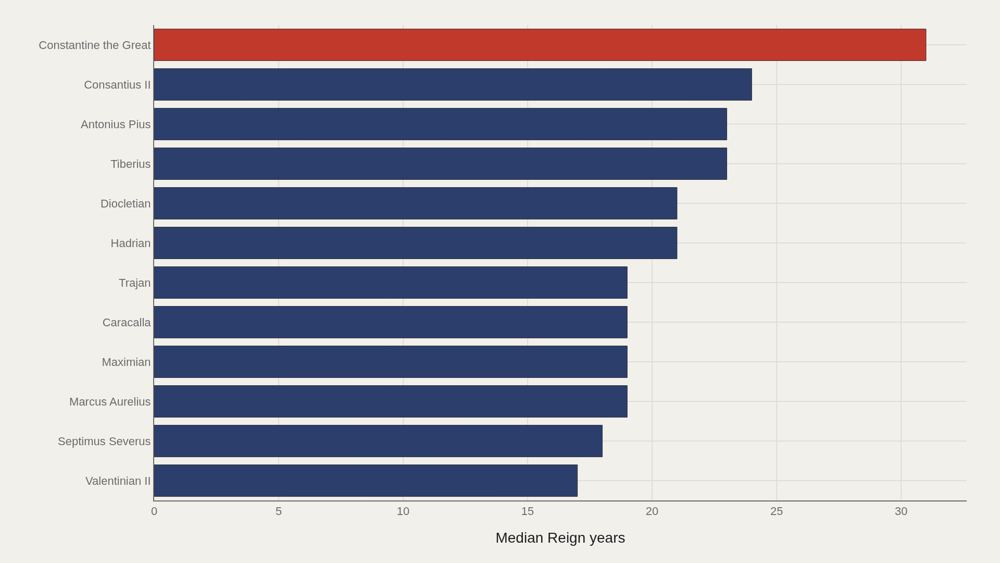
Constantine the Great leads at 31.0 reign years. Valentinian II anchors the low end of the top group at 17.0—still far above the file median of 6.50. The chart shows a curated upper slice, not the full distribution. Grouping by name makes the catalog's major entities comparable on a single scale. The question is not who is famous, but who lasted. The gap between Constantine and the rest of the top tier shows that longevity was exceptional rather than routine. Constantine's 306–337 CE reign sits at a hinge in Roman institutional history: civil war, Tetrarchic succession, Christian legalization after the Edict of Milan, the Council of Nicaea in 325, and the foundation of Constantinople all fall inside or around his rule. The dataset reduces that to 31.0 years, but the named entity carries enough historical context to explain why the ceiling is not a spreadsheet oddity.
The top dozen still sits far above the median emperor
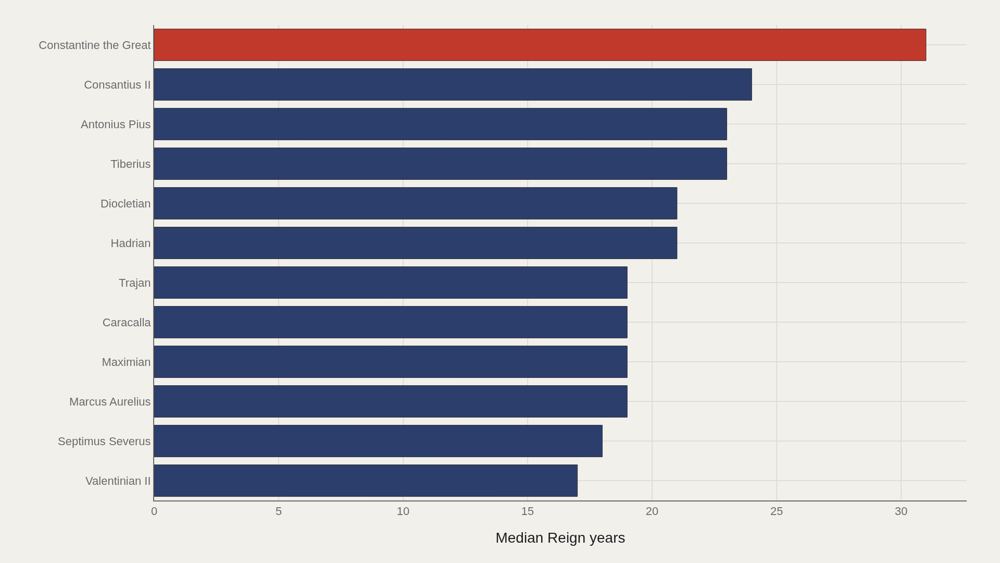
Among the top dozen emperors, the median is 20.0 years—three times the full-file median of 6.50. Even the typical elite tenure in this slice is a different political animal from the typical emperor in the dataset. That separation matters for interpretation. Leaderboards describe the right tail, not Rome's everyday succession reality, which lived closer to half a decade than to two decades. The 20.0-year median among the top dozen contains the familiar names that make imperial history feel more stable than it was: Augustus, Tiberius, Hadrian, Antoninus Pius, Marcus Aurelius, Constantine. The full-file median pulls the reader back toward usurpers, assassinations, co-rule, civil wars, and short-lived crisis reigns.
Dynasty boxes show contested, not uniform, tenure
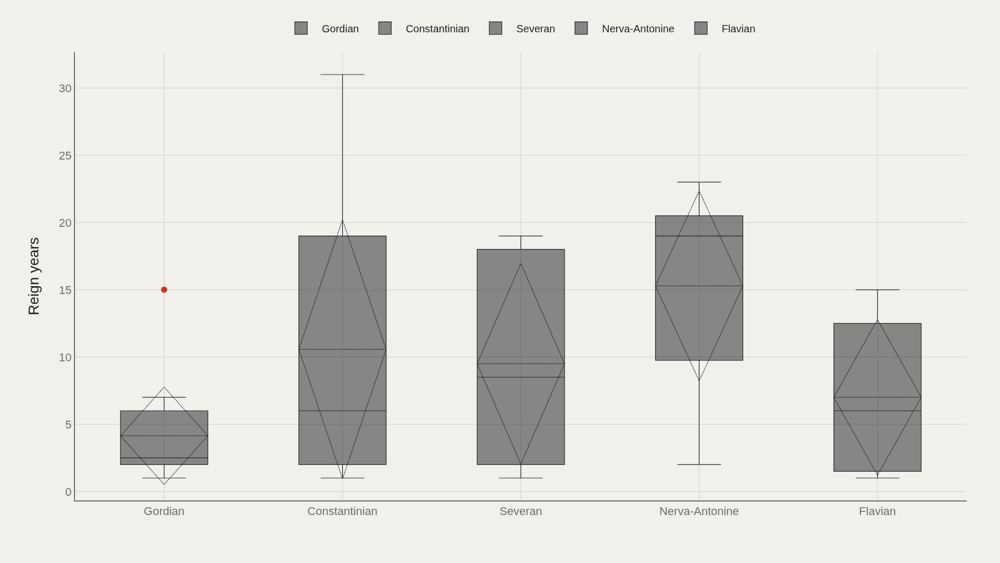
When reign years are split by dynasty, the boxes do not collapse into a single shared consensus. Some houses stretch higher; others sit tighter and lower. The spread shows dynasty is a contested axis for tenure rather than deterministic. Read the boxes as structural signals: belonging to a named dynasty did not automatically purchase Constantine-length stability. It bought a distribution, and those distributions differ. The Nerva-Antonine adoption sequence has long been associated with high imperial stability, while the third-century crisis illustrates how military acclamation and rapid turnover can shred dynastic continuity. The box plot asks whether succession packages mattered—and the answer is yes, but variably.
Nerva–Antonine sits above the median; Gordian trails
Relative to the file median, Nerva-Antonine sits 12.5 years above; Gordian trails by 4.0. That is the cleanest dynasty-level contrast in the gap chart: one house systematically above the center of the distribution, another systematically below. Gordian is also the most common dynasty label in the fact boxes—volume without longevity. Frequency of naming and length of rule are not the same political achievement. The Nerva-Antonine result aligns with the conventional account of fewer violent turnovers and longer administrative horizons in the second century. A positive gap does not prove the dynasty caused stability, but it matches the historical pattern. The Gordian contrast points to the opposite problem. Gordian I and Gordian II ruled briefly in 238 CE during the Year of the Six Emperors, while Gordian III lasted longer but still belongs to a crisis environment shaped by military pressure and senatorial maneuvering. A repeated dynasty label can mark a famous rupture rather than a durable house.
What to take away
The median emperor lasted 6.50 years. Constantine the Great lasted 31.0. Dynasty membership did not flatten that gap. Nerva–Antonine clears the median by 12.5 years; Gordian, despite being the most common dynasty label, trails it by 4.0.
■ END
The Fine PrintBack of the BoxEnd Credits
NoteWarningsDisclaimer
Artometrics data brief. Figures come from the sources below. Derived shares and editorial indices are not audited financials.
SourcesContentsSources
- SourceData Science Learning Community. (2019). TidyTuesday: Roman Emperors. https://raw.githubusercontent.com/rfordatascience/tidytuesday/main/data/2019/2019-08-13/emperors.csv
- SourceData Science Learning Community. (2019). TidyTuesday Roman Emperors source folder. https://github.com/rfordatascience/tidytuesday/tree/main/data/2019/2019-08-13
- SourceBoatwright, M. T., Gargola, D. J., Lenski, N., & Talbert, R. J. A. (2012). The Romans: From Village to Empire (2nd ed.). Oxford University Press.
- SourcePotter, D. S. (2014). The Roman Empire at Bay, AD 180–395 (2nd ed.). Routledge. https://doi.org/10.4324/9780203080971
- SourceAndo, C. (2012). Imperial Rome AD 193 to 284: The Critical Century. Edinburgh University Press. https://edinburghuniversitypress.com/book-imperial-rome-ad-193-to-284.html
- ReportFull report: artometrics.com/emperors
MethodAssemblyMethod
Numbers in this issue are the published figures. The skin changes type, rules, and chart color only.
PlatesMade byImage credits
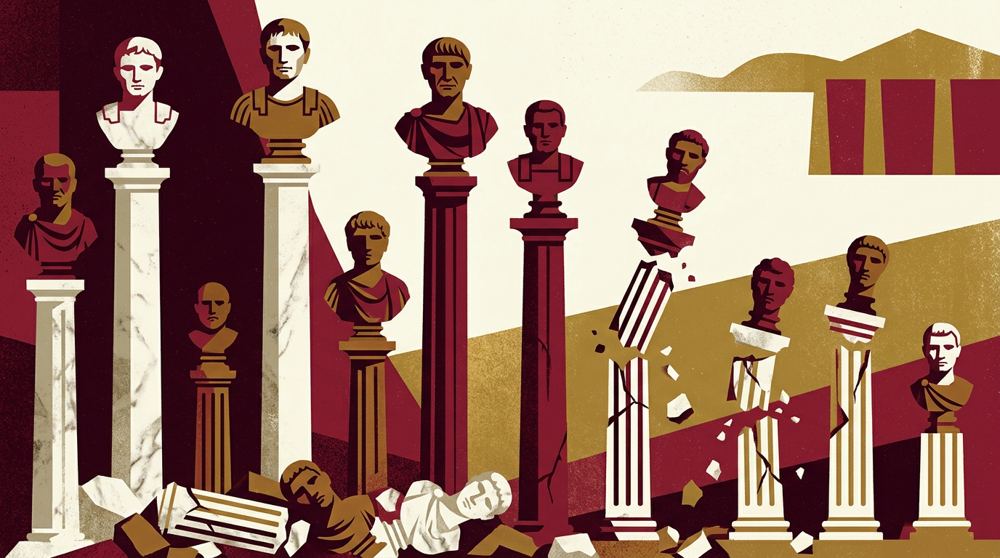
- HeroArtometrics Emperors illustration.
- PlatePortrait of Luca Pacioli, attributed to Jacopo de' Barbari, c. 1495. Public domain, via Wikimedia Commons.
- PlateColor print of a toy shop, Utagawa Sadahide, 1860. The Metropolitan Museum of Art, CC0, via Wikimedia Commons.
- PlateBelasco Theatre box office, published November 1907 in Architects' and Builders' Magazine. Unknown photographer. Public domain, via Wikimedia Commons.


Updated through JUN 15, 2026.