

JUN 15, 2026 · Nations
Nations
Five Countries Hold 72% of World Population
China's 1.36 billion against a 5.2 million median — the top five countries hold 72% of aggregate population in the CIA World Factbook extract.
By Kyle McAuliffe · · 3 min
China's 1,355,692,576 people sit against a global median of 5,220,371 in the CIA World Factbook extract — a 260-fold gap that drives every concentration metric. The top five countries hold 72% of aggregate population; most nations operate at a scale closer to the median than to the summit.
Mean population (~32 million) sits far above the median because a handful of giants pull the average upward. The distribution is right-skewed: 218 of 259 entries fall into the smallest bin.
259
Factbook entries with complete population data
5,220,371
Median population; mean is 32,294,361 due to right skew
72%
Aggregate population share held by the top five countries
A Handful of Giants Dominate Headcount
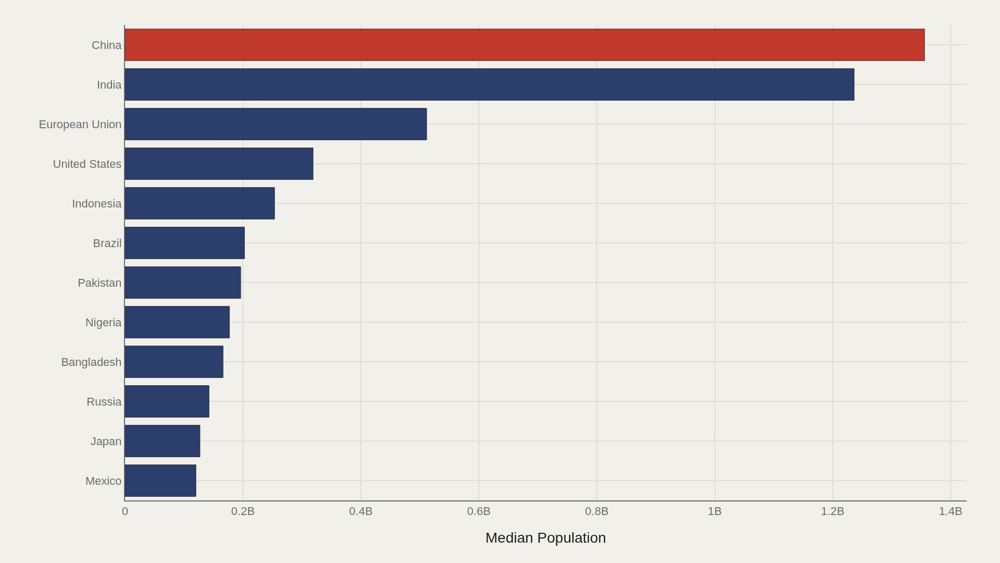
China leads at 1.36 billion, India at 1.24 billion, the European Union aggregate near 511 million, the United States near 319 million, Indonesia near 254 million, and Brazil near 203 million. These six operate in a different scale class than the median country at 5.2 million. They are not outliers; they are the architectural beams of every global concentration statistic.
Even the Top Dozen Has a Steep Internal Drop
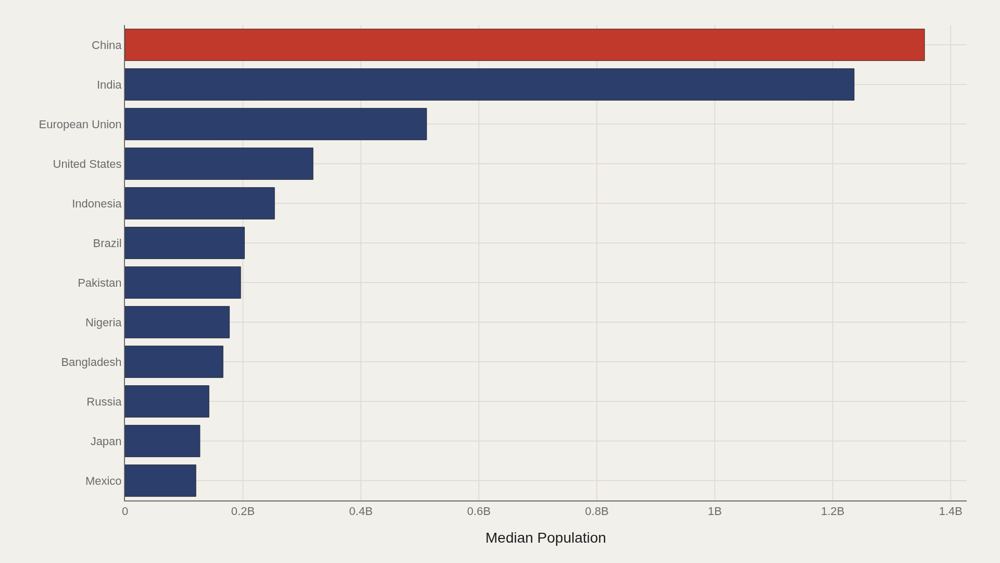
Within the top twelve, the median is 199,415,584 — less than one-sixth of China's total. The drop from first to sixth is steeper than the drop from sixth to twelfth. "Large country" is a pyramid, not a plateau. Second-tier giants are already far smaller than the demographic summit.
Most Countries Sit in the Small-Population Mass
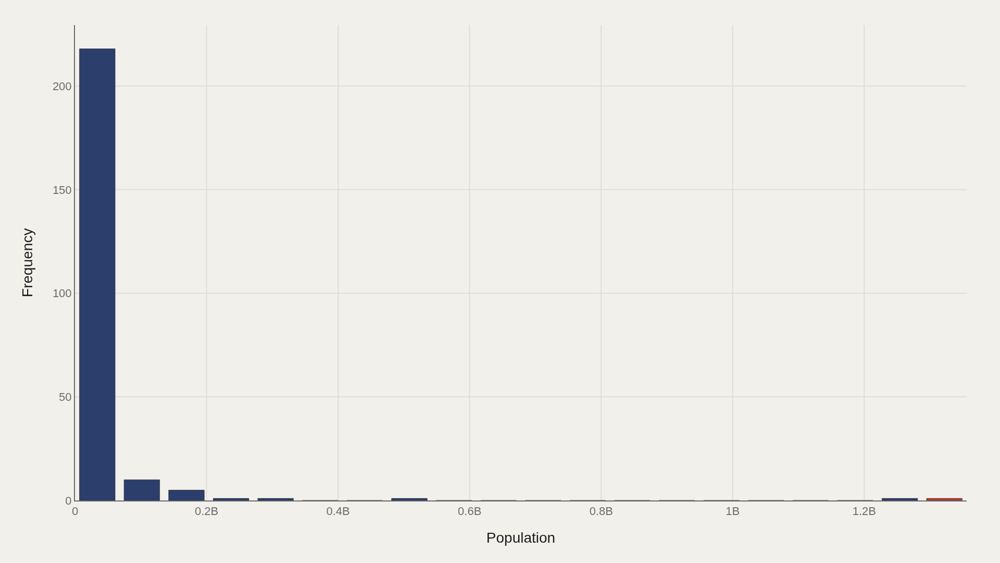
The first bin holds 218 of 259 entries. Only a handful of observations reach the billionaire tier or approach it. The median (5.2 million) describes the typical country; the mean (~32 million) is pulled upward by the giants. Use the median when the question is "most countries" and the top five when the question is "most people."
The Top Five Already Hold Most of the People
The Pareto curve shows the top five countries accounting for 72% of aggregate population. By fifteen entries the curve approaches the full plotted total. Global population is not evenly distributed across flags. It is concentrated in a short list of demographic powers.
High Birth Rates Cluster Among Smaller Populations
Birth rates above 40 per 1,000 cluster among countries well below the mega-population tier. Several large countries sit at lower birth rates. Demographic giants are not fertility leaders. Scale and birth rate are independent stories in the Factbook.
What to take away
In 259 Factbook rows, the median country has 5.2 million people while China exceeds 1.35 billion. The top five entries hold 72% of the aggregate in the concentration view.
Cite the median for a typical state; cite China, India, and the Pareto share when the question is planetary concentration.
■ END
The Fine PrintBack of the BoxEnd Credits
NoteWarningsDisclaimer
Artometrics data brief. Figures come from the sources below. Derived shares and editorial indices are not audited financials.
SourcesContentsSources
MethodAssemblyMethod
Numbers in this issue are the published figures. The skin changes type, rules, and chart color only.
PlatesMade byImage credits
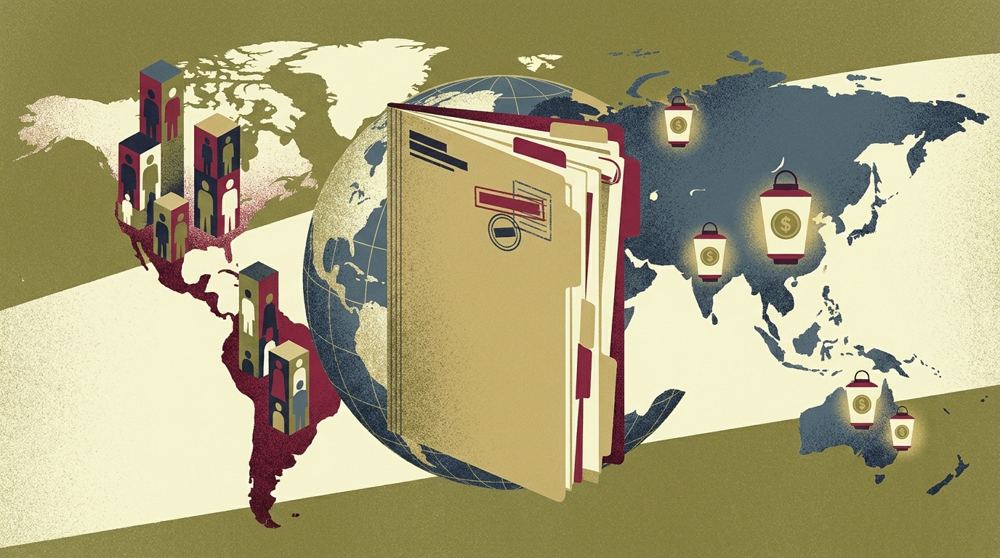
- HeroArtometrics Nations illustration.
- PlatePortrait of Luca Pacioli, attributed to Jacopo de' Barbari, c. 1495. Public domain, via Wikimedia Commons.
- PlateColor print of a toy shop, Utagawa Sadahide, 1860. The Metropolitan Museum of Art, CC0, via Wikimedia Commons.
- PlateBelasco Theatre box office, published November 1907 in Architects' and Builders' Magazine. Unknown photographer. Public domain, via Wikimedia Commons.


Updated through JUN 15, 2026.