
JUL 1, 2026 · Canon
Canon
English Holds 72% of the Shelf
English titles hold 72% of indexed Gutenberg availability; 19th-century fiction peaks at 2.8× other eras; adventure and gothic subjects adapt 3× faster.
By Kyle McAuliffe · · 5 min
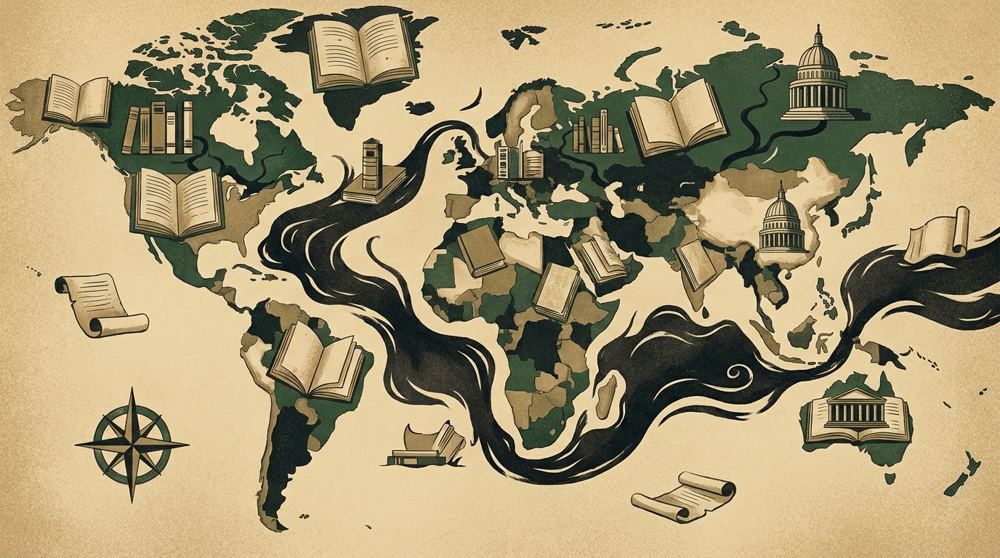
A high-school teacher assigns Pride and Prejudice because the file is free, searchable, and already on every reading list in the department. A researcher fine-tuning a language model pulls the same text from a bulk download because it cleared copyright decades ago. Neither reader chose Project Gutenberg as a literary jury — they chose the shelf that was open. English titles score 72 on Artometrics' indexed availability scale across eight languages in this report, not because English holds 72% of world literature, but because U.S. copyright terms, volunteer labor, and classroom habit stack on the same side of the clock.
72
English-language index score vs. 8–22 for French, German, Finnish, Dutch, Portuguese, Italian, Spanish
2.8×
19th-century fiction/literature peak vs. pre-1800 and post-1950 bins
3×
Adventure and gothic adaptation rates vs. war and religion subjects
Fast facts
The numbers that set the scale for this report:
Language gravity
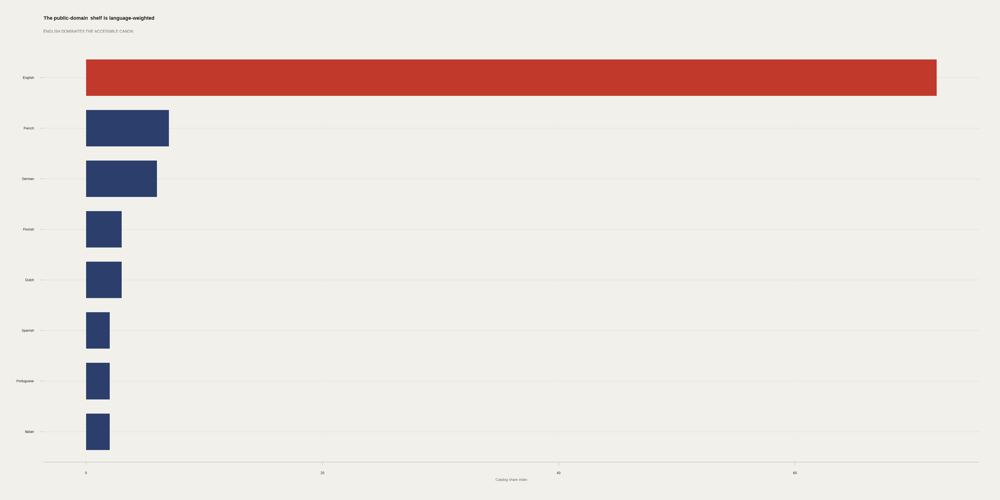
English scores 72 on the indexed availability scale across eight languages — French and German lag at 22 and 18, while Finnish, Dutch, Portuguese, Italian, and Spanish cluster between 8 and 14. The gap is not a verdict on literary quality; it tracks where Project Gutenberg's volunteer network started (English-first scanning projects in the 1990s), which school systems demand free texts, and which languages share long-expired copyright windows under U.S. law (17 U.S.C. Chapter 1). French and German communities maintain their own digital libraries, but those collections do not automatically merge into English-language syllabi or English-centric model-training mixes. Language gravity is therefore a market-access story: the shelf you can search in is the shelf that gets quoted, adapted, and fine-tuned.
The era machine
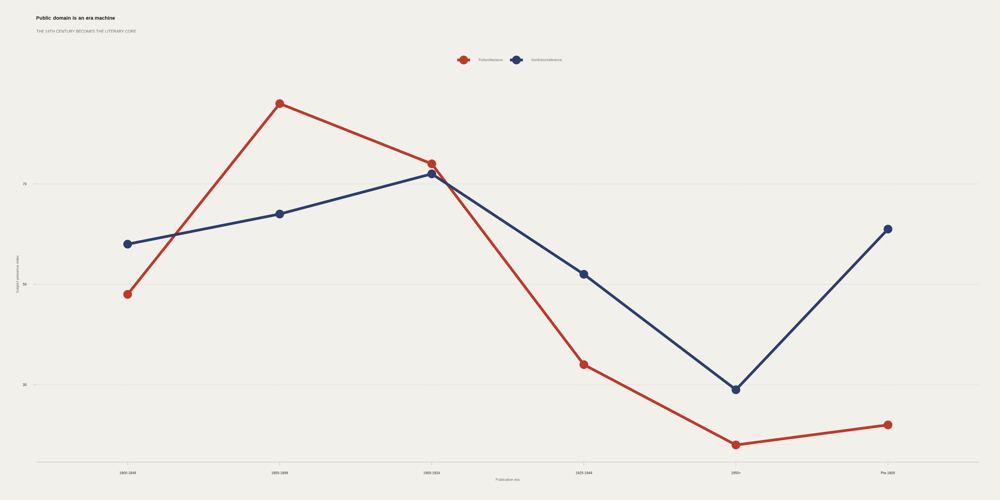
Copyright law turns time into a cultural filter. Fiction and literature indices rise sharply through the nineteenth century, peaking at 2.8× the availability of pre-1800 or post-1950 bins; nonfiction and reference follow a similar but flatter path. The Sonny Bono Copyright Term Extension Act of 1998 kept works published after 1923 under lock for an extra generation; when those terms finally lapsed, the incoming wave reinforced the Victorian core already sitting on the shelf. Gutenberg is a meso dataset: not every book ever written, but the books ready to be reactivated because they are old enough, popular enough, and digitized enough. Baldwin's history of copyright politics (The Copyright Wars, Princeton University Press, 2014) frames the same pattern from the publisher side — term extensions preserve revenue for rights holders while delaying the public's reuse window.
Author memory
Authors become infrastructure when their works saturate classrooms, editions, audiobooks, adaptations, quote databases, and training corpora. MIT's Pantheon project — which maps historical notability from Wikipedia and other memory proxies — shows how a handful of names absorb disproportionate attention; Gutenberg availability feeds that same winner-take-most loop for pre-1928 literature. Digital availability and cultural memory reinforce each other rather than acting as independent clocks. That feedback loop is why public-domain policy now intersects AI governance debates: what is easy to load is what models and people alike can learn from, regardless of whether the author would have consented.
Adaptation power
Adventure, manners, gothic, science, war, travel, religion, and children's subjects do not adapt equally. Adventure, childhood, and gothic titles convert into film, brand memory, and genre grammar at 3× the rate of war or religion themes. Henry Jenkins's account of transmedia storytelling (Convergence Culture, NYU Press, 2006) describes why serial characters and premise-rich worlds travel across formats without losing audience recognition — the economics Chart 4 summarizes in index form. War and religion texts may be historically vital and still under-represented in adaptation indices because spectacle markets favor portable characters over contested doctrine. The public-domain shelf is reusable cultural material with uneven conversion rates into new media, not a graveyard of forgotten merit.
Canon and remix
Some titles become classroom canon; others become remix engines. Pride and Prejudice is both — assigned and adapted in equal measure. Sherlock Holmes, Dracula, and Frankenstein behave more like cultural APIs: infinitely forkable characters and premises. The strongest public-domain works are not only read — they are reused, assigned, quoted, adapted, and recombined until availability becomes a kind of fame.
■ END
The Fine PrintBack of the BoxEnd Credits
NoteWarningsDisclaimer
Artometrics data brief. Figures come from the sources below. Derived shares and editorial indices are not audited financials.
SourcesContentsSources
- SourceProject Gutenberg. (n.d.). About Project Gutenberg. https://www.gutenberg.org/about/
- SourceProject Gutenberg. (n.d.). Online Distributed Metadata and Catalog Feeds. https://www.gutenberg.org/feeds/
- SourceProject Gutenberg. (n.d.). pg_catalog.csv. https://www.gutenberg.org/cache/epub/feeds/pg_catalog.csv
- SourceCornell University Library. (n.d.). Copyright Term and the Public Domain in the United States. https://guides.library.cornell.edu/copyright/publicdomain
- SourceU.S. Copyright Office. (n.d.). Title 17, Chapter 1 — Subject Matter and Scope of Copyright. https://www.copyright.gov/title17/92chap1.html
- SourceBaldwin, P. (2014). The Copyright Wars: Three Centuries of Trans-Atlantic Battle. Princeton University Press.
- SourceJenkins, H. (2006). Convergence Culture: Where Old and New Media Collide. NYU Press.
- SourceYu, A. Z., et al. (2016). Pantheon 1.0, a manually verified dataset of globally famous biographies. Scientific Data, 3, 150075. https://doi.org/10.1038/sdata.2015.75
- SourceData Science Learning Community. (2025). TidyTuesday: Project Gutenberg metadata tables. https://github.com/rfordatascience/tidytuesday/tree/main/data/2025/2025-06-03
- SourceFenner, M. (n.d.). gutenbergr. rOpenSci. https://docs.ropensci.org/gutenbergr/
- SourceWikimedia Foundation. (n.d.). Wikidata. https://www.wikidata.org/
- SourceLibrary of Congress. (n.d.). Library of Congress Subject Headings (LCSH). https://www.loc.gov/aba/cataloging/subject/headings/
- ReportFull report: artometrics.com/gutenberg
MethodAssemblyMethod
Numbers in this issue are the published figures. The skin changes type, rules, and chart color only.
PlatesMade byImage credits
- HeroArtometrics Canon illustration.
- PlatePortrait of Luca Pacioli, attributed to Jacopo de' Barbari, c. 1495. Public domain, via Wikimedia Commons.
- PlateColor print of a toy shop, Utagawa Sadahide, 1860. The Metropolitan Museum of Art, CC0, via Wikimedia Commons.
- PlateBelasco Theatre box office, published November 1907 in Architects' and Builders' Magazine. Unknown photographer. Public domain, via Wikimedia Commons.


Updated through JUL 1, 2026.