


SEP 22, 2026 · Dynasties
Dynasties
When Dynasties Are Systems
Yankees, Patriots, Celtics, Cowboys: a synthesis of Artometrics' sports-dynasty reports asks what transfers when winning is a system, not a roster.
By Kyle McAuliffe · · 5 min
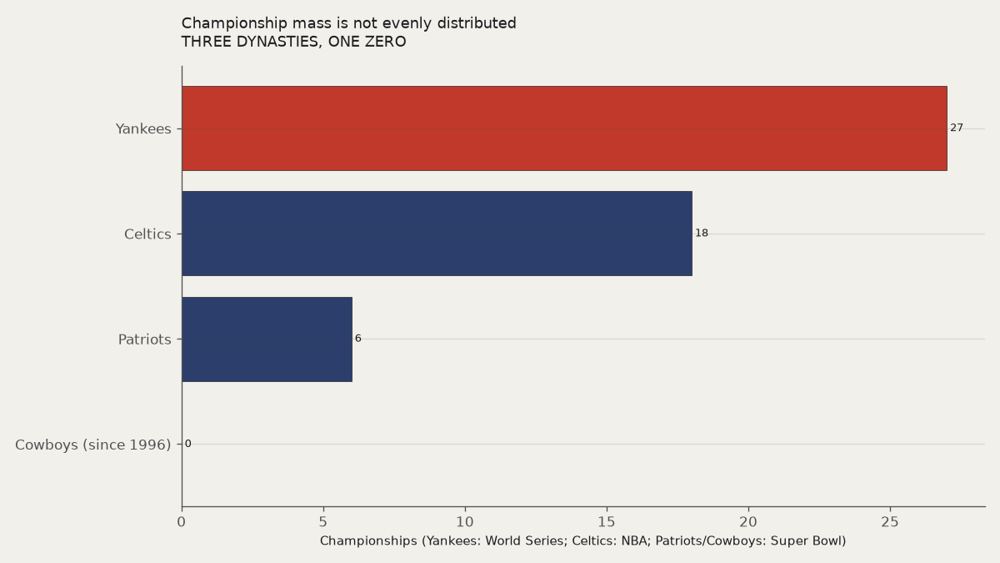
Three Artometrics reports already established the raw numbers: the Yankees' 27 World Series titles, the Patriots' six Super Bowls in 19 seasons, and the Celtics' 18 NBA championships, the league record entering 2025. None of those reports asked the question this one does — what, if anything, transfers across sports when a dynasty outlives the star who built it, and where does spending alone fail to substitute for it.
27
Yankees World Series titles at a 40% Finals conversion rate
6
Patriots Super Bowl championships in 19 seasons, a 55% conversion rate across 9 appearances
18
Celtics NBA championships, the league record entering 2025, with 11 in the Russell era
Star gravity vs. institutional continuity
This is the framework's actual contribution — an editorial typology, not a new measurement. Two of the three source reports describe dynasties whose championship archives outlived their most famous single star. The sports-dynasty index's own sibling pieces on the Lakers ("how the Lakers convert star gravity into title eras") and the Warriors ("the franchise that rewrote basketball offense") describe a different mechanism: championship output that tracks the presence of a specific, dominant talent core. Call that star-gravity. The Patriots and Celtics reports describe something else: system dynasties, where coaching, front-office structure, or multi-generational institutional identity keeps producing championships across rosters that do not share a single defining star. The Patriots won six titles under one quarterback-coach pairing; the Celtics won 18 across five distinct eras — Russell, Havlicek, Bird, Pierce/Garnett, and Tatum/Brown, per the Celtics report's own era buckets — a continuity no single star's career could span.
When spending doesn't convert: Cowboys and Padres
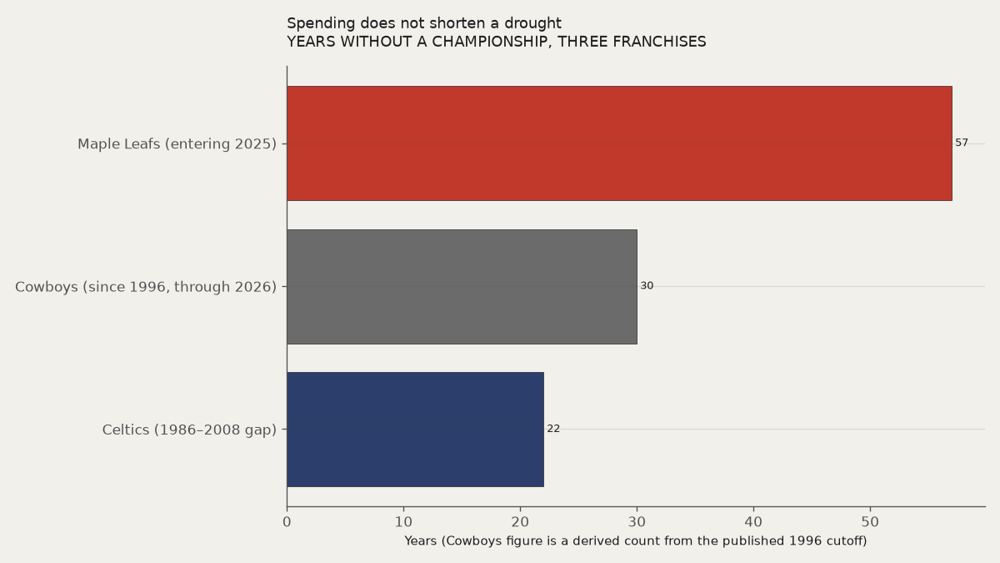
The sports-dynasty index's third finding is the cleanest evidence against treating market value as a proxy for competitive output: the Cowboys have won zero Super Bowls since their 1990s dynasty ended in 1996, despite ranking in the top five of NFL franchise valuations every year since. The same report cites the Maple Leafs' 57-season active Stanley Cup drought entering 2025 as the longest among high-value franchises in any of the four leagues it compares. Elsewhere in the Artometrics archive, the Padres report frames the same failure in dollar terms — a reported $3.9bn in spending against zero championships. None of these three cases lack resources. What they lack, by the sports-dynasty index's own framing, is whatever the Patriots and Celtics reports describe as the system: a repeatable institutional mechanism for converting access — Finals appearances, playoff berths, big-name signings — into titles. Spending buys attention and access. It does not, on this evidence, buy conversion.
The Patriots test: what survives the star's departure
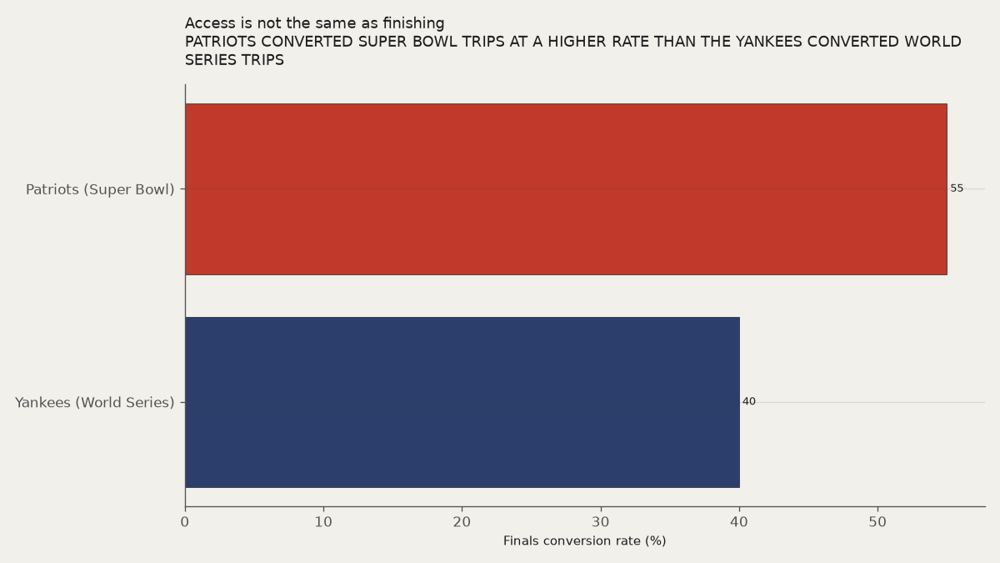
The Patriots report's own numbers are the strongest system-dynasty case in the corpus: six championships and nine Super Bowl appearances between 2001 and 2019, a 55% conversion rate — 6 of 11 all-time Super Bowl appearances — that the sports-dynasty index singles out as the highest among dynasty-tier franchises since 1950. That conversion rate exceeds even the Yankees' 40%, despite the Yankees holding more than four times the total championship count. The Patriots report itself frames 2020 — the first season without Tom Brady — as the hinge point where brand capital stayed high while football output did not automatically follow. That report leaves the question open rather than answering it: whether the infrastructure (coaching continuity, personnel evaluation, a specific institutional culture) survives the departure of the star who anchored it. This synthesis does not resolve that question with new data; it names it as the central test case for the star-gravity vs. system distinction, because the Patriots dynasty is the one cited case in the corpus where the star left and the institution kept operating without him.
Conclusion
Across the three source reports, championship mass, conversion efficiency, and institutional durability turn out to be separate variables, not one. The Yankees carry the largest archive without the highest conversion rate; the Patriots carry the highest conversion rate on a much smaller archive; the Celtics carry both a large archive and a proven ability to survive a 22-year interruption. The Cowboys and, per the Padres report, the Padres show that none of this is guaranteed by spending alone.
■ END
The Fine PrintBack of the BoxEnd Credits
NoteWarningsDisclaimer
Artometrics data brief. Figures come from the sources below. Derived shares and editorial indices are not audited financials.
SourcesContentsSources
- SourceArtometrics. Which Sports Dynasties Convert Finals Appearances Into Championships? (source report.)
- SourceArtometrics. Six Super Bowls in 19 Seasons — The Patriots' Systemic Discontinuity (source report.)
- SourceArtometrics. 18 NBA titles have turned the Celtics into a franchise judged against its own history (source report.)
- SourceRelated Artometrics report: Lakers
- SourceRelated Artometrics report: Warriors
- SourceRelated Artometrics report: Dodgers
- SourceRelated Artometrics report: Padres
- SourceRelated Artometrics report: Cowboys
- ReportFull report: artometrics.com/institutions
MethodAssemblyMethod
Numbers in this issue are the published figures. The skin changes type, rules, and chart color only.
PlatesMade byImage credits
- HeroArtometrics Dynasties illustration.
- PlatePortrait of Luca Pacioli, attributed to Jacopo de' Barbari, c. 1495. Public domain, via Wikimedia Commons.
- PlateColor print of a toy shop, Utagawa Sadahide, 1860. The Metropolitan Museum of Art, CC0, via Wikimedia Commons.
- PlateBelasco Theatre box office, published November 1907 in Architects' and Builders' Magazine. Unknown photographer. Public domain, via Wikimedia Commons.


Updated through SEP 22, 2026.