

SEP 22, 2026 · Jackson
Jackson
The Cost of Being the Product
A Psychonomics profile of Michael Jackson — Thriller's 34× RIAA certification, the 2016 Sony/ATV deal, and the disputed allegations on the same ledger.
By Kyle McAuliffe · · 5 min
Economics manages the house. Psychonomics asks who manages the soul of the house — and what that architecture costs. Julius Caesar scaled the self into a state, absorbed by patronage. Beyoncé scaled the self into a firm, governed by Parkwood. Michael Jackson scaled the self into a product: the catalog was the body, Neverland was the household myth, and the public was invited to consume both directly, for decades, without a clean line between the artist and the object for sale.
34×
Thriller's RIAA certification, the most-certified album in RIAA history
$750M
Sony's reported 2016 buyout of the Jackson estate's 50% stake in Sony/ATV Music Publishing
$825M
Forbes-reported 2016 earnings for the Jackson estate, at the time the highest single-year figure Forbes had recorded for any celebrity
Leadership Trait Analysis
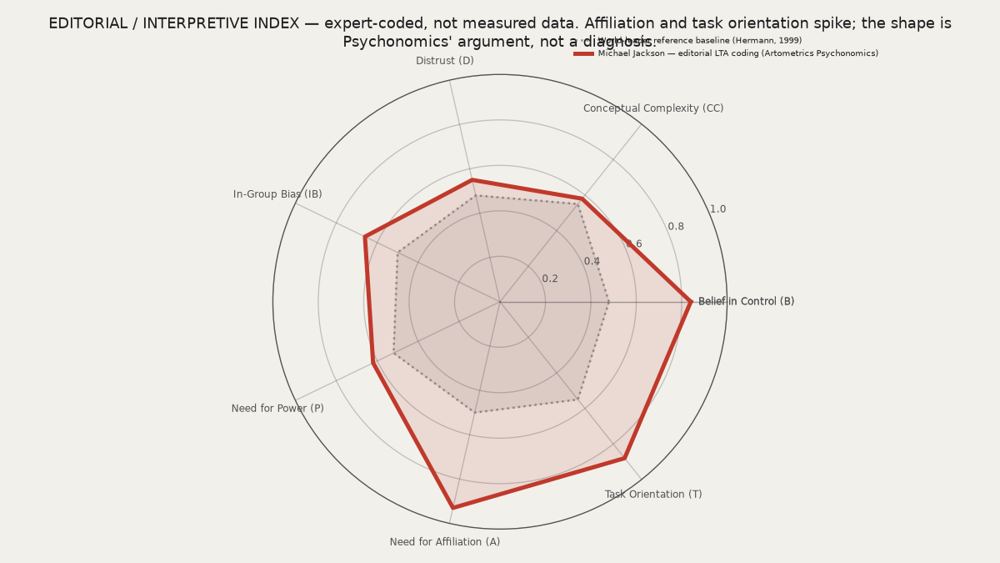
Jackson's coded profile is not Caesar's shape (near-ceiling power, near-floor distrust) or Beyoncé's shape (ceiling task and control with an owned firm at the center). It spikes hardest on Need for Affiliation (A = 0.93) — the documented, career-long drive to be loved by an audience directly, at scale — paired with Task Orientation (T = 0.88), visible in the meticulous, self-directed control Jackson exercised over choreography, production, and stagecraft. Belief in Ability to Control Events (B = 0.84) is also elevated, consistent with a performer who treated the show, the image, and eventually the estate as things that could be engineered. Need for Power (P = 0.62) and Conceptual Complexity (CC = 0.58) sit closer to the baseline; this is not a profile built around institutional or political power. Read this way, Jackson's psychonomic argument is not "the self as institution" (Caesar) or "the self as firm" (Beyoncé). It is the self as the thing being sold directly to an audience it needed to love it back — a performer-affiliation shape rather than a governance shape. That is the interpretive hinge for the rest of this report: when affiliation this high is the organizing need, the persona and the product become very hard to separate, for the audience and for the person.
The catalog as body
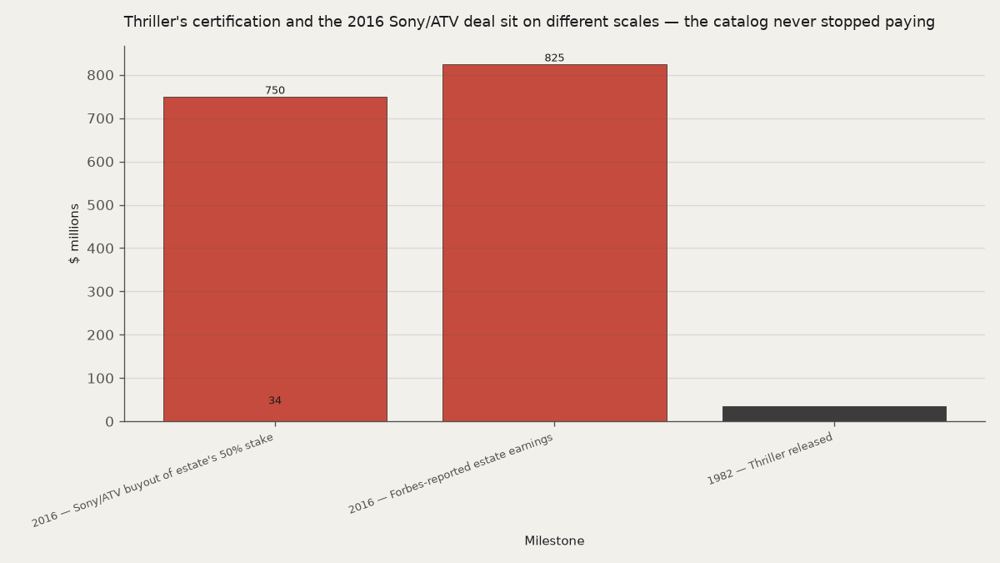
Thriller was released in 1982 and is RIAA-certified 34× Platinum as of the RIAA's most recent certification update — the best-certified album in the organization's history. That certification measures units, not years, but the years matter here: it kept accumulating long after 1982, through re-releases, catalog streaming, and the posthumous attention that followed Jackson's 2009 death. In March 2016, Sony bought out the Jackson estate's 50% stake in the Sony/ATV Music Publishing catalog for a reported $750 million, as widely reported at the time by Reuters and Billboard. That same year, Forbes' "Top-Earning Dead Celebrities" list reported the Jackson estate earning $825 million in 2016 — at the time, the highest single-year figure Forbes had ever recorded for any celebrity, living or dead. Those three numbers sit on different units — a certification count and two dollar figures seven years apart in origin but landing in the same calendar year — and this report does not collapse them into one index. What they show together is a catalog that behaved, financially, as if the person behind it were still actively productive: a 2016 valuation event and a 2016 earnings record, both keyed to a body of work made mostly in the 1980s. The commercial afterlife did not simply persist; at points it out-earned the living-era peak years.
The dual ledger
If Beyoncé is control of the house, Jackson is what happens when the house is the product. The two charts above do not share an axis, and that is not an oversight — it is the finding. The commercial ledger (Chart 1) shows a catalog that kept generating peak-scale value in 2016, seven years after Jackson's death and roughly two decades after the criminal case that dominated public attention in 2003–2005. The legal ledger (Chart 2) shows a set of dated events — an undisclosed 1994 settlement, a 2005 acquittal, a 2009 death, a 2019 documentary — that never produced a criminal conviction, but also never fully receded from public discussion.
■ END
The Fine PrintBack of the BoxEnd Credits
NoteWarningsDisclaimer
Artometrics data brief. Figures come from the sources below. Derived shares and editorial indices are not audited financials.
SourcesContentsSources
- SourceHermann, M.G. (1999). Assessing Leadership Style: A Trait Analysis. Social Science Automation.
- SourceRecording Industry Association of America (RIAA). Gold & Platinum certification search — Michael Jackson, Thriller. riaa.com.
- SourceReuters. (2016). Sony buys out Michael Jackson estate's stake in music publisher Sony/ATV for $750 million.
- SourceBillboard. (2016). Coverage of the Sony/ATV buyout of the Michael Jackson estate's 50% stake.
- SourceForbes. (2016). Top-Earning Dead Celebrities list — Michael Jackson estate, $825 million.
- SourcePeople v. Jackson, Santa Barbara County Superior Court (2003–2005) — trial record and June 2005 acquittal on all 14 counts.
- SourceLeaving Neverland (2019). HBO documentary — renewed allegations; Michael Jackson estate public statements and legal filings disputing the film.
- SourceArtometrics. (2026). Julius Caesar and the Cost of Managing Power — Psychonomics method template. artometrics.com/caesar
- SourceArtometrics. (2026). Beyoncé and the Cost of Controlling the House — Psychonomics series. artometrics.com/beyonce
- SourceSupporting chart files: /data/articles/jackson/charts/ (chart1_catalog_milestones.plotly.json, chart2_legal_timeline.plotly.json, chart3_lta_radar.plotly.json).
- ReportFull report: artometrics.com/jackson
MethodAssemblyMethod
Numbers in this issue are the published figures. The skin changes type, rules, and chart color only.
PlatesMade byImage credits
- HeroArtometrics Jackson illustration.
- PlatePortrait of Luca Pacioli, attributed to Jacopo de' Barbari, c. 1495. Public domain, via Wikimedia Commons.
- PlateColor print of a toy shop, Utagawa Sadahide, 1860. The Metropolitan Museum of Art, CC0, via Wikimedia Commons.
- PlateBelasco Theatre box office, published November 1907 in Architects' and Builders' Magazine. Unknown photographer. Public domain, via Wikimedia Commons.


Updated through SEP 22, 2026.