
JUN 15, 2026 · Gutenberg
Gutenberg
69,027 Headings Anchor Gutenberg's Core
LCSH accounts for 69% of subject headings; PS (American literature) appears 4,684 times — concentration defines the reusable public-domain canon.
By Kyle McAuliffe · · 4 min

Library of Congress Subject Headings (lcsh) account for 69,027 records in a 100,000-row TidyTuesday extract of Project Gutenberg — 69% of all subject entries. The catalog is not a popularity contest; it is a map of which public-domain books volunteers could digitize and classify at scale.
Subject code PS — American literature — recurs 4,684 times, leading all labels. A short head of repeated classifications anchors the catalog while most subject entities appear once. The pattern is typical of library metadata: a reusable canon of headings, and a long inventory of singleton assignments.
Reading Gutenberg as a concentration map of reusable works is where the data help.
69,027
lcsh records dominate the 100,000-row dataset, defining the catalog core
4,684
PS (American literature) subject appearances, the most repeated label
Power-law distribution
most subjects appear once; a reusable canon of headings anchors repeated use
Public-domain books cluster by subject type
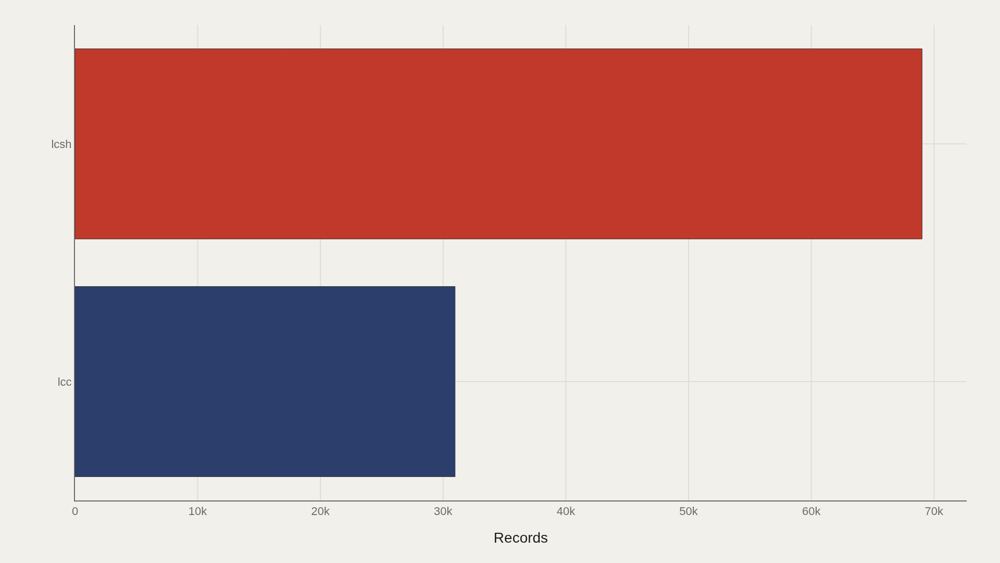
lcsh dominates with 69,027 records, far ahead of thinner subject-type buckets. The main classification family carries the story; this field does not split into many equal long-tail types. That concentration means most navigational claims about what Gutenberg contains are really claims about how LCSH-style headings organize the digitized shelf.
A small set of subjects anchors the catalog
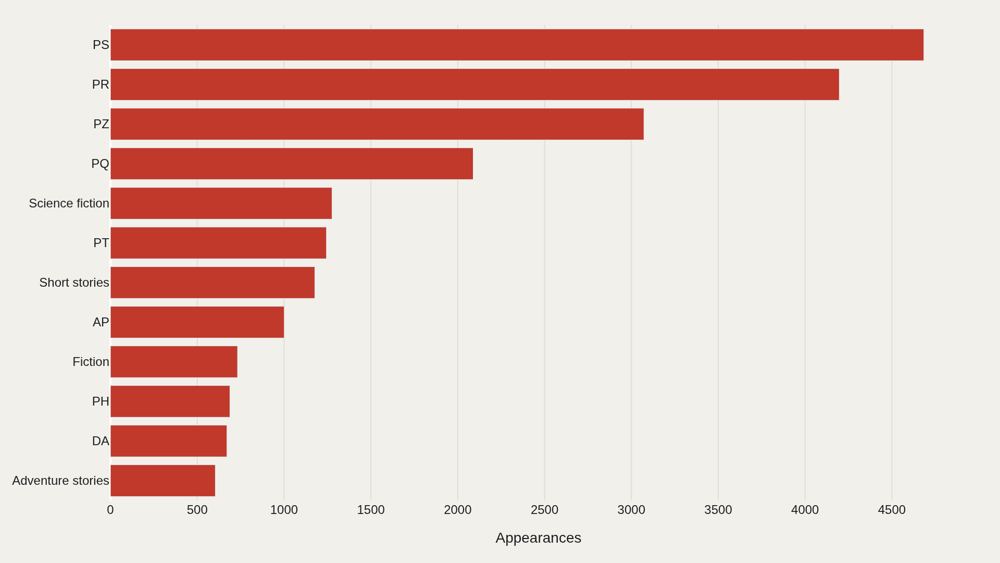
PS appears 4,684 times — the most recurring subject name in the file. The top dozen account for a visible share of all 100,000 rows even though most subject entities appear only once. American literature codes, fiction labels, and related headings form a reusable core. They are the catalog's gravitational center for teachers, scrapers, and adaptation hunters.
Subject families show the catalog center of gravity
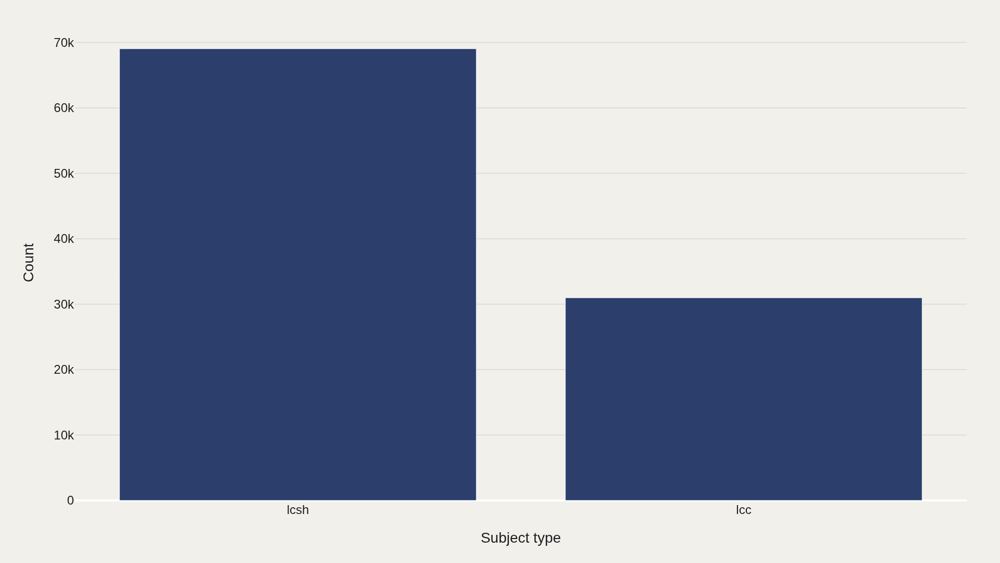
lcsh is again the largest bucket on the category chart. Subject families show where editorial attention should focus first if the goal is to understand the shelf's center of gravity rather than its exotic edges. The edges still matter for discovery. They do not define the statistical middle of a 100,000-row extract.
Repeated subjects reveal the reusable canon
Most subject entities appear only once; a small head recurs repeatedly. That power-law shape is typical of catalog tables: a reusable canon of headings, and a long inventory of singleton classifications. Repeated subjects are the ones most likely to support classroom packs, themed collections, and machine-learning corpora. Frequency is a reuse forecast as much as a shelf description.
Subject labels become the map of the shelf
PS and related labels become the map of the shelf when numeric scores are sparse. Frequency leaders reveal franchise depth in literature the way studio logos reveal franchise depth in film. The practical claim for cultural analytics is simple: if you can only afford to study a slice of Gutenberg, the repeated subject head is where coverage of the reusable public-domain canon begins.
What to take away
Gutenberg's subject catalog is concentrated: lcsh dominates subject type, a short head of codes such as PS recurs thousands of times, and most labels appear once.
The citable lesson is about reusable canon. Public-domain literature becomes infrastructure when classification and digitization make the same subjects easy to find again and again.
■ END
The Fine PrintBack of the BoxEnd Credits
NoteWarningsDisclaimer
Artometrics data brief. Figures come from the sources below. Derived shares and editorial indices are not audited financials.
SourcesContentsSources
- SourceData Science Learning Community. (2025). TidyTuesday: Project Gutenberg (curated via {lcshr}). https://github.com/rfordatascience/tidytuesday/tree/main/data/2025/2025-06-03
- SourceData Science Learning Community. (2025). TidyTuesday: lcsh_subjects.csv. https://raw.githubusercontent.com/rfordatascience/tidytuesday/main/data/2025/2025-06-03/lcsh_subjects.csv — subject types and labels (lcsh, lcc, and related fields)…
- SourceFenner, M. (n.d.). lcshr: Download and Process Public Domain Works from Project Gutenberg. rOpenSci. https://docs.ropensci.org/lcshr/
- SourceProject Gutenberg. (n.d.). Project Gutenberg. https://www.gutenberg.org/
- SourceLibrary of Congress. (n.d.). Library of Congress Subject Headings (LCSH). https://www.loc.gov/aba/cataloging/subject/headings/
- ReportFull report: artometrics.com/lcsh
MethodAssemblyMethod
Numbers in this issue are the published figures. The skin changes type, rules, and chart color only.
PlatesMade byImage credits
- HeroArtometrics Gutenberg illustration.
- PlatePortrait of Luca Pacioli, attributed to Jacopo de' Barbari, c. 1495. Public domain, via Wikimedia Commons.
- PlateColor print of a toy shop, Utagawa Sadahide, 1860. The Metropolitan Museum of Art, CC0, via Wikimedia Commons.
- PlateBelasco Theatre box office, published November 1907 in Architects' and Builders' Magazine. Unknown photographer. Public domain, via Wikimedia Commons.


Updated through JUN 15, 2026.