
JUN 15, 2026 · Medium
Medium
Do Four-Minute Medium Posts Earn More Claps?
78,388 Medium articles from 2017–2018 show median reading time of 4 minutes; scatter plots reveal no clean law linking length to applause.
By Kyle McAuliffe · · 4 min

Medium's median reading time sits at 4.00 minutes across 78,388 articles from 2017–2018 — a short-form default that holds steady even as a thin tier of hour-scale essays pushes the right tail past 100 minutes.
The open question is whether longer posts earned more applause. Reading time and claps are related enough to chart and messy enough that a single correlation will not settle the culture of the platform. The highest observed reading time — 100 minutes — belongs to a month-long chess-mastery quest; Towards Data Science is the most common publication label in the file.
The metadata trail — reading time, claps, publication tags — lets that promise be tested without reading every essay. Scatter plots reveal no clean law linking length to applause.
78,388
Medium article records in the working dataset
4.00
Median reading time in minutes across the full file
100
Highest observed reading time, a month-long chess quest that anchors the extreme tail
How reading time moved
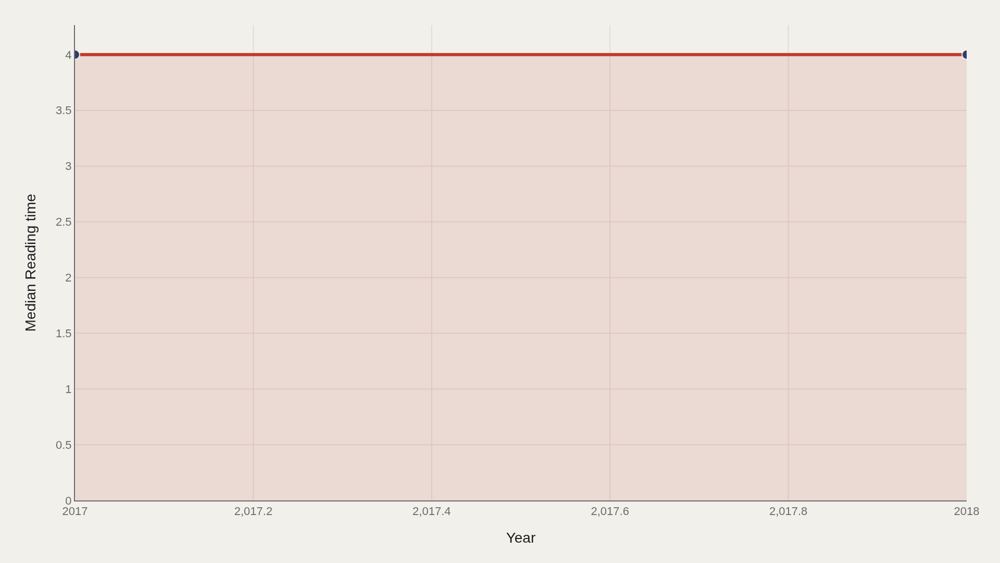
Across the 2017–2018 window, median reading time stays near 4.00 minutes from opening period to close. Stability at the median does not mean the tails were quiet — only that the typical post length did not shift during the snapshot. A flat median is still informative: whatever clap dynamics existed in this period were not driven by a wholesale move toward longer or shorter default essays.
Who sits at the top of length
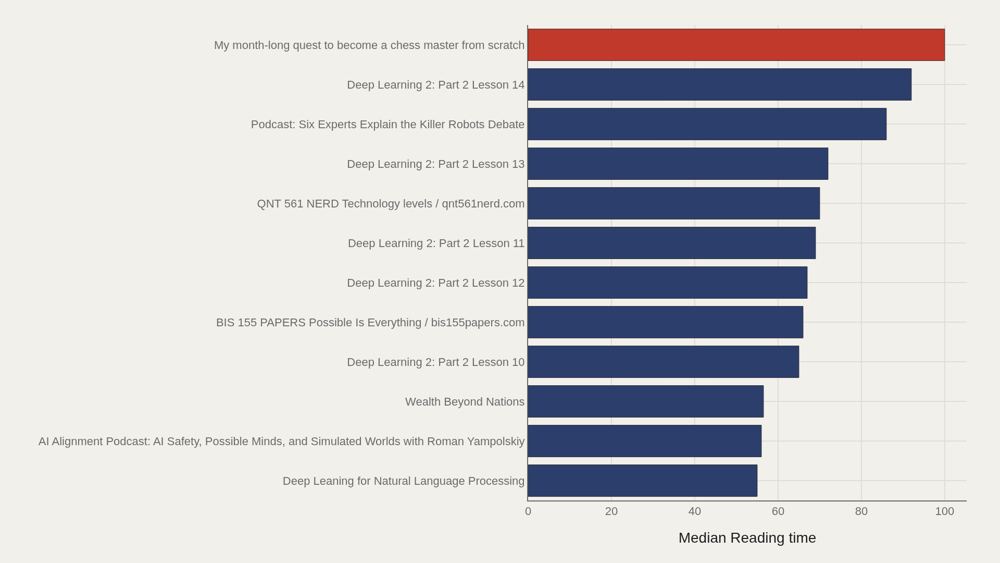
My month-long quest to become a chess master from scratch leads at 100 minutes of estimated reading time. The median among the top dozen is 68.0 — more than fifteen times the file-wide median of 4 minutes. Deep-learning lesson writeups, AI alignment podcasts, and longform data essays populate the same extreme band. The length frontier of Medium in this file is a specialist pedagogy genre as much as a literary one.
How publications spread length
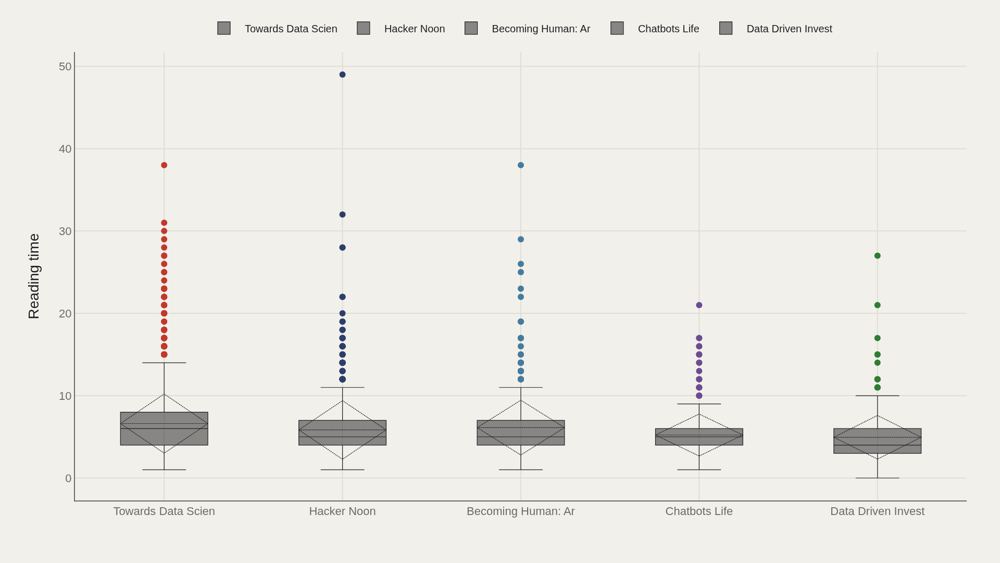
Publication box plots show whether reading-time consensus is shared or contested across houses. Some publications cluster tightly around short explainers; others tolerate or encourage long technical serials. Towards Data Science's frequency as the most common publication does not make it the longest. Volume of posts and length of posts are different editorial strategies that coexist under one brand.
Who beats the median — and who trails
Towards Data Science sits 2.00 minutes above the median on the gap chart; Data Driven Investor trails by 0.00 in the highlighted comparison — effectively on the median line in that cut. Publication gaps of a couple of minutes sound small until you remember the median is only four. A two-minute lift is a 50% longer typical article in that house's mix.
Reading time and claps
Plotting reading time against claps shows clusters that averages erase. Many short posts earn modest applause; some long posts earn a lot; some long posts earn almost none. Length is not a reliable applause machine. If there is a relationship, it is noisy and genre-dependent. Tutorial serials and viral short takes can both succeed. The scatter kills the slogan that longer always wins without replacing it with the opposite.
What to take away
Most Medium posts in this file are short: median reading time of four minutes. A thin upper tier stretches to hour-scale essays, especially in technical and quest narratives.
The citable answer to the title question is cautious: longer posts sometimes earn more claps, but the scatter refuses a clean law. Publication norms and genre explain as much as length alone.
■ END
The Fine PrintBack of the BoxEnd Credits
NoteWarningsDisclaimer
Artometrics data brief. Figures come from the sources below. Derived shares and editorial indices are not audited financials.
SourcesContentsSources
- SourceThe source is the TidyTuesday release from 2018-12-04 (R for Data Science community). The working file contains 78,388 rows and 22 columns after assembly — titles, publications, reading time, claps, and related metadata.
- ReportFull report: artometrics.com/medium
MethodAssemblyMethod
Numbers in this issue are the published figures. The skin changes type, rules, and chart color only.
PlatesMade byImage credits
- HeroArtometrics Medium illustration.
- PlatePortrait of Luca Pacioli, attributed to Jacopo de' Barbari, c. 1495. Public domain, via Wikimedia Commons.
- PlateColor print of a toy shop, Utagawa Sadahide, 1860. The Metropolitan Museum of Art, CC0, via Wikimedia Commons.
- PlateBelasco Theatre box office, published November 1907 in Architects' and Builders' Magazine. Unknown photographer. Public domain, via Wikimedia Commons.


Updated through JUN 15, 2026.