

SEP 22, 2026 · Narratives
Narratives
The Field Guide Culture Workers Needed
A working framework for treating economic narratives as contagious, falsifiable objects — built from Shiller and Kuran, not a proprietary dataset.
By Kyle McAuliffe · · 5 min

Everyone in culture and business says "the narrative changed." Almost nobody can define a narrative as an economic object with a shape, a lifespan, and a falsifier. Robert Shiller's narrative economics treats popular stories as contagious — with something like an infection phase, mutation into new slogans, and eventual burnout — that move markets and institutions independent of whether the underlying facts are true. This is the briefing note for culture workers tired of vibes language.
2019
Publication year of Robert Shiller's "Narrative Economics," the book that treats popular stories as contagious economic objects
1995
Publication year of Timur Kuran's "Private Truths, Public Lies," the source of the preference-falsification concept used here
4
Worked cases applying the framework: crypto, the pandemic, meme stocks, and celebrity scandal
Definitions
Four terms carry the whole piece, and they are used precisely, not loosely:
Crypto Fights Its Own Counter-Narrative, Not Just the Market
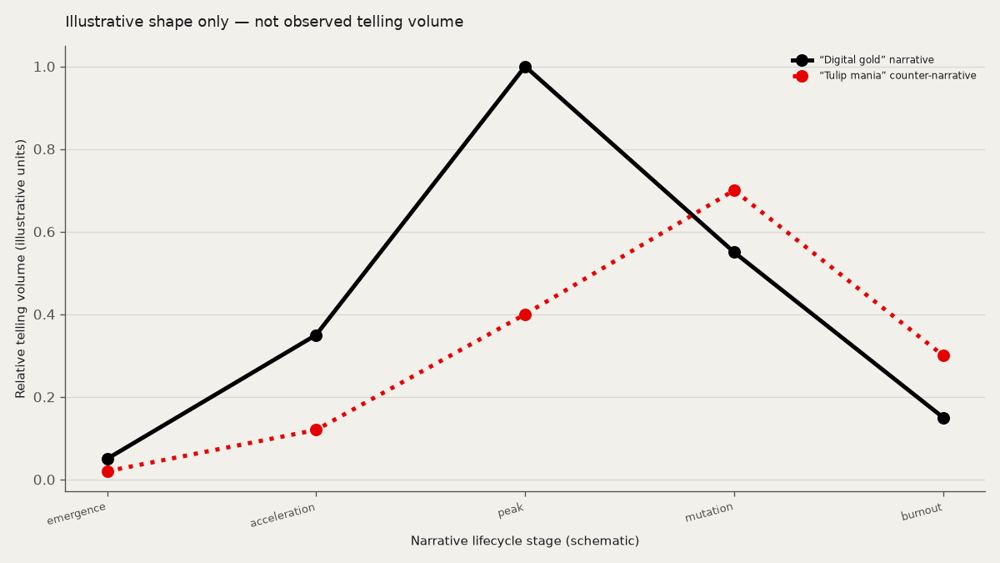
Crypto's central narrative pairing is "digital gold" against "tulip mania." Neither slogan is a data point; each is a compressed argument standing in for a longer case — one for scarcity-as-store-of-value, one for speculative mania with no fundamental floor. Shiller's framework predicts exactly this shape: a dominant narrative provokes a counter-narrative that borrows the same contagious mechanics, and the two compete for the same finite pool of attention rather than debating on a shared evidentiary ledger. Whichever slogan is easier to retell at a given moment — not whichever is more accurate — tends to win the news cycle. The operator lesson is to measure slogan volume, not theology. An analyst who tries to adjudicate whether crypto "really is" digital gold is answering the wrong question for a narrative-economics purpose. The tractable question is which slogan is currently spreading faster, because that is the variable actually moving retail flows, media coverage, and regulatory posture in the near term — independent of which side eventually turns out to be right.
Pandemic-Era Narratives Ran as Three Competing Epidemics
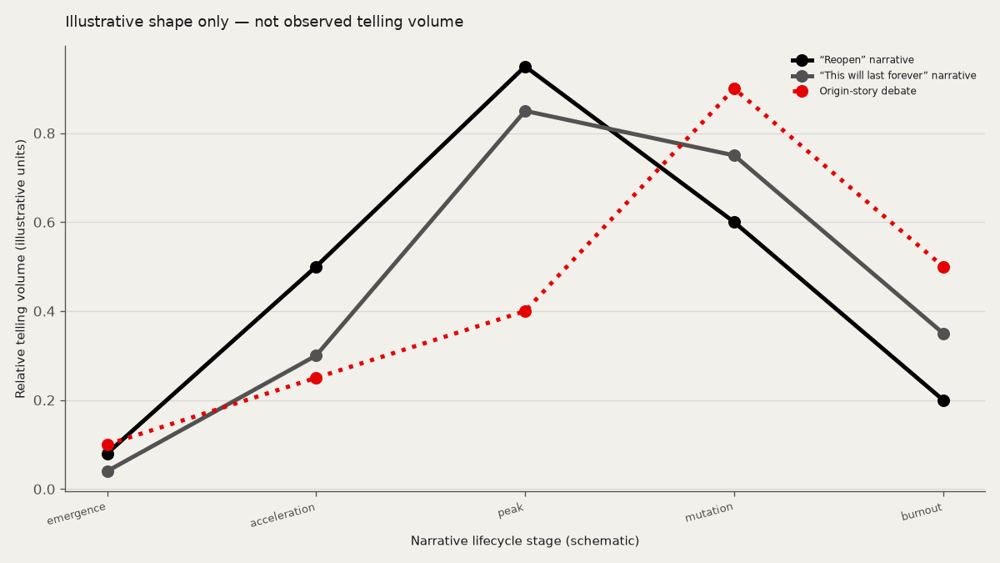
The COVID era produced at least three narratives running in parallel rather than in sequence: "reopen now," "this will last forever," and a set of origin-story debates about where the outbreak began. Each had its own emergence point, its own peak, and — crucially for Shiller's framework — its own mutation path once the simplest version of the slogan stopped holding attention. "Reopen" mutated into arguments about specific sectors and age groups; "this will last forever" mutated into permanent-remote-work and permanent-behavior-change variants that outlived the acute phase of the crisis itself. What makes this case instructive for operators is that the three narratives were not simply competing for accuracy — they were competing for which one got to define the decision frame for employers, venues, and policymakers at a given moment. A business that briefed only on case counts and ignored which narrative currently held the floor was, in Shiller's terms, missing half the variable that was actually moving foot traffic, staffing decisions, and event cancellations.
Meme-Stock Trading Turned a Story Into a Coordination Device
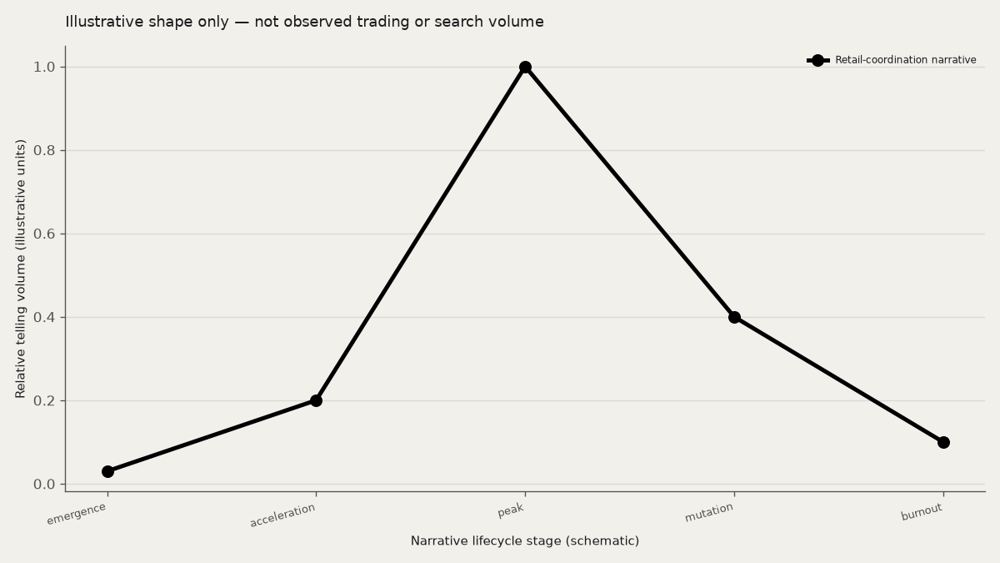
The retail-trading surge in stocks like GameStop in January 2021 is a widely reported, real event, and it is a clean illustration of a narrative functioning as a coordination device rather than an information signal. The story — that a dispersed group of retail traders could act together against concentrated institutional short positions — did not need to be a complete or even fair account of market structure to work. It needed to be simple enough, and morally legible enough, that a large number of people could act on it at close to the same time without a central organizer. This is Shiller's "common knowledge" mechanism in its purest form: what moved the trade was not private conviction about fundamentals, but public confidence that enough other people believed the same story and were acting on it simultaneously. The narrative's economic function was coordination, not forecasting — and it is exactly the kind of case where asking "was the story true?" is less useful than asking "was the story contagious enough to synchronize behavior?"
Monday brief template
The practical output of this framework is a four-step brief any culture or business operator can run before a Monday meeting, a pitch, or a planning cycle:
■ END
The Fine PrintBack of the BoxEnd Credits
NoteWarningsDisclaimer
Artometrics data brief. Figures come from the sources below. Derived shares and editorial indices are not audited financials.
SourcesContentsSources
- SourceShiller, R. J. (2019). Narrative Economics: How Stories Go Viral and Drive Major Economic Events. Princeton University Press.
- SourceKuran, T. (1995). Private Truths, Public Lies: The Social Consequences of Preference Falsification. Harvard University Press.
- SourceArtometrics Editorial. The Protection Threshold — a related Artometrics report examining the "why didn't we know sooner" mechanism as a measurable point of institutional silence collapse in Hollywood.
- ReportFull report: artometrics.com/narratives
MethodAssemblyMethod
Numbers in this issue are the published figures. The skin changes type, rules, and chart color only.
PlatesMade byImage credits
- HeroArtometrics Narratives illustration.
- PlatePortrait of Luca Pacioli, attributed to Jacopo de' Barbari, c. 1495. Public domain, via Wikimedia Commons.
- PlateColor print of a toy shop, Utagawa Sadahide, 1860. The Metropolitan Museum of Art, CC0, via Wikimedia Commons.
- PlateBelasco Theatre box office, published November 1907 in Architects' and Builders' Magazine. Unknown photographer. Public domain, via Wikimedia Commons.


Updated through SEP 22, 2026.