
JUL 1, 2026 · Oscars
Oscars
How Award Shows Build Prestige
How Oscars, Grammys, and Nobels manufacture legitimacy differently. Oscar prestige ties to market; Nobel prestige ties to institutional memory.
By Kyle McAuliffe · · 5 min
Award shows are culture's accounting departments. They translate messy creative fields into categories, winners, speeches, snubs, and canon—then ask the public to treat those boxes as settled judgment.
98th
Academy Awards database complete through 2025/2026 cycle — defines the scale of Oscar gatekeeping
1,500+
Acceptance speeches in Academy database — preserve names, faces, and prestige moments as searchable text
1901
First Nobel Prizes awarded — establish the institutional memory model that outlasts annual media cycles
Prestige and market are not the same currency
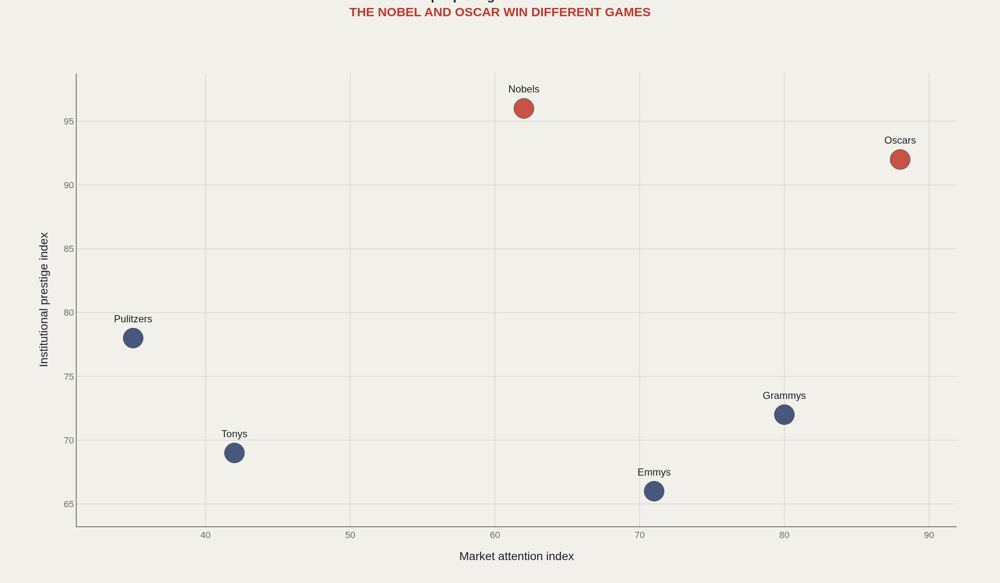
The Oscar and the Nobel both signal prestige, but they serve different publics. One is wired into box office, campaigns, and red-carpet media; the other into universities, citation networks, and institutional history. Ranking them on a single "fame" scale collapses those circuits. The cleaner move is to separate prestige currency from market currency—then watch how each prize spends both. The Academy of Motion Picture Arts and Sciences operates inside a commercial release economy where campaigns, distributors, studios, guild screenings, and trade publications shape visibility. The Nobel Foundation operates inside a much slower institutional field, where the Swedish Academy, Karolinska Institute, Royal Swedish Academy of Sciences, and Norwegian Nobel Committee produce records meant to outlive annual media cycles. That institutional contrast is why an Oscar for a film such as Oppenheimer in the 2024 ceremony and a Nobel Prize in Physiology or Medicine for Katalin Karikó and Drew Weissman in 2023 do different kinds of cultural work. One reorganizes a film's market and canon position after release; the other backdates scientific legitimacy onto a line of research, institutions, and citations that may have been building for decades.
When awards invent more lanes of excellence
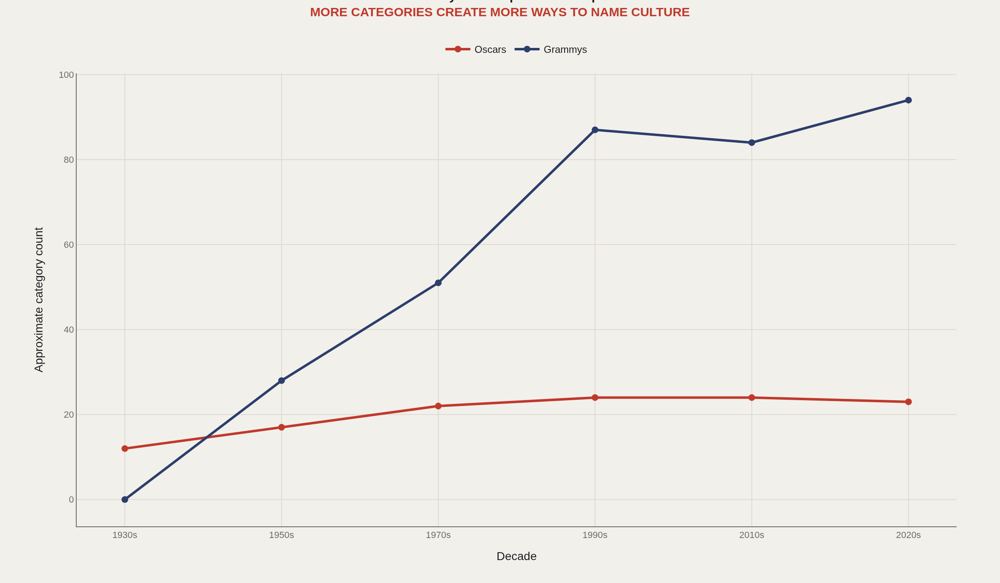
Award shows are taxonomies. When categories expand, culture gets more official boxes, more winners, and more arguments about who belongs. The Grammys make the pattern clearest: genre fragmentation becomes institutional design. More lanes mean more legitimacy to distribute—and more fights over whether a win still means the same thing. The Recording Academy's category list encodes this most directly because popular music continually splits by genre, format, language, output role, and performance context. Rap, Latin, global music, electronic music, music video, immersive audio, and songwriter categories all reflect industry politics about which labor deserves a named lane. Category expansion is an archive of market change. The Oscars expand more slowly, but their category debates still reveal institutional priorities: animated feature became a category at the 74th Academy Awards, international feature replaced the older foreign-language label, and the Academy has repeatedly debated stunt work, casting, and popular-film recognition. Each change decides whether a kind of labor becomes visible on the official ledger.
Getting nominated is not the same as winning
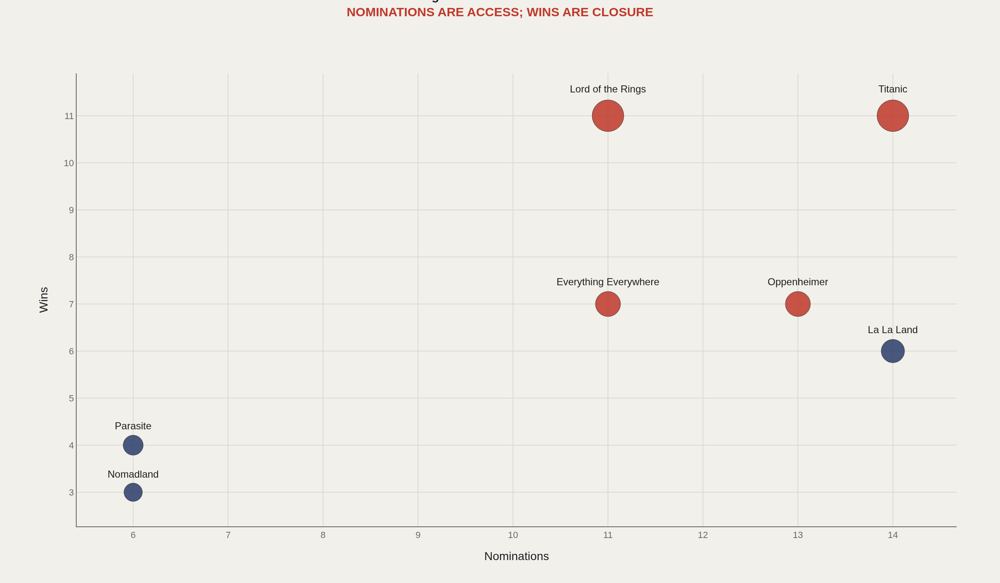
Nominations measure access to the prestige room. Wins measure coalition strength, timing, category fit, and narrative closure. That is why Oscar season often reads like political analysis in evening wear: access is one contest; conversion is another. The distinction is visible in the Academy database itself. Meryl Streep's long nomination record, John Williams's composing nominations, and Walt Disney's historical accumulation of Oscars all show that repeated access is its own status. A win requires the right category, year, campaign, and consensus among voters. Science prizes have a parallel but slower conversion problem. A Nobel committee cannot nominate every important collaborator, and prize rules limit how many laureates can share a scientific award. That is why Rosalind Franklin's absence from the 1962 DNA recognition and the 2020 Chemistry prize for CRISPR-Cas9 became public examples of how nomination and credit systems compress collaborative discovery into a few names.
What the public actually remembers
Best Picture matters inside the industry. Acting, artist, and star categories travel faster through casual conversation. Institutions do the sorting; people carry the names. Prestige that never sticks to a face tends to fade into ballot trivia. The Academy's acceptance-speech database makes the face-and-name economy literal: speeches preserve recipients, presenters, studios, collaborators, parents, agents, and political moments as searchable text. The public may forget the exact category order, but it often remembers Halle Berry's 2002 Best Actress speech, Bong Joon Ho's 2020 sweep with Parasite, or the 2017 Best Picture envelope error involving Moonlight and La La Land. The Nobel system creates a different memory path. Names such as Marie Curie, Albert Einstein, Toni Morrison, Malala Yousafzai, and Martin Luther King Jr. travel as civic and educational symbols beyond the original prize citation. In both cases, institutions sort the archive, but individual names make the archive portable.
■ END
The Fine PrintBack of the BoxEnd Credits
NoteWarningsDisclaimer
Artometrics data brief. Figures come from the sources below. Derived shares and editorial indices are not audited financials.
SourcesContentsSources
- SourceAcademy of Motion Picture Arts and Sciences. Academy Awards Database.
- SourceOscars.org. Awards Databases and Acceptance Speech Database.
- SourceNobel Prize. Public prize and laureate data/API documentation.
- SourceDLu/oscar_data. Curated Academy Award nomination dataset with identifiers.
- SourceRecording Academy public Grammy records and Wikidata award tables.
- SourceAcademy of Motion Picture Arts and Sciences. Academy Awards Database. https://awardsdatabase.oscars.org/
- SourceAcademy of Motion Picture Arts and Sciences. Academy Awards Acceptance Speech Database. https://aaspeechesdb.oscars.org/
- SourceNobel Prize Outreach. Nobel Prize API. https://www.nobelprize.org/about/developer-zone-2/
- SourceThe Recording Academy. GRAMMY Awards rules and guidelines. https://www.grammy.com/awards/rules-guidelines
- SourceEnglish, J. F. (2005). The Economy of Prestige: Prizes, Awards, and the Circulation of Cultural Value. Harvard University Press.
- ReportFull report: artometrics.com/oscars
MethodAssemblyMethod
Numbers in this issue are the published figures. The skin changes type, rules, and chart color only.
PlatesMade byImage credits
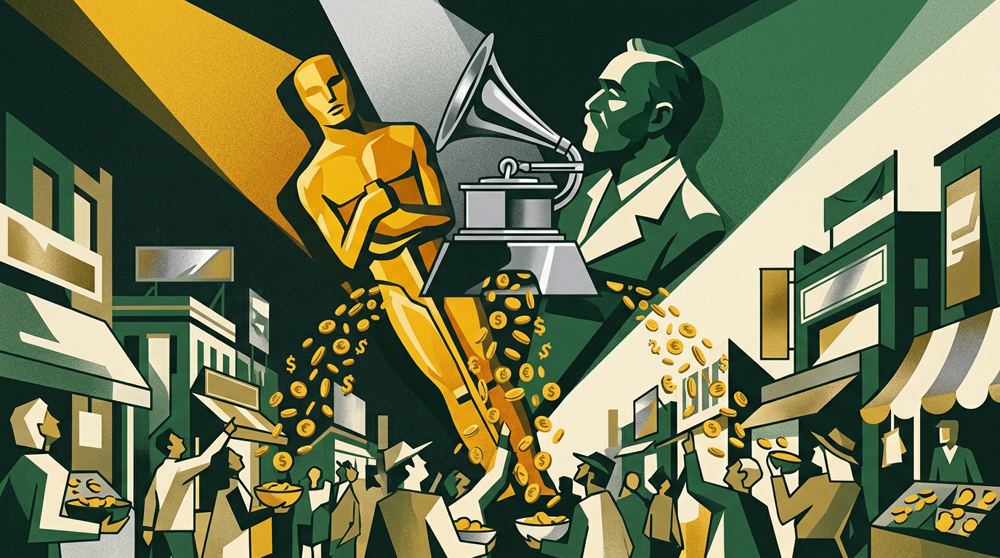
- HeroArtometrics Oscars illustration.
- PlatePortrait of Luca Pacioli, attributed to Jacopo de' Barbari, c. 1495. Public domain, via Wikimedia Commons.
- PlateColor print of a toy shop, Utagawa Sadahide, 1860. The Metropolitan Museum of Art, CC0, via Wikimedia Commons.
- PlateBelasco Theatre box office, published November 1907 in Architects' and Builders' Magazine. Unknown photographer. Public domain, via Wikimedia Commons.


Updated through JUL 1, 2026.