
SEP 22, 2026 · Playboy
Playboy
When the Brand Outlives the House
Hefner died in 2017. In 2024 his son's $100M+ bid to buy back Playboy's legacy was rejected. What survives a founder who was the product?
By Kyle McAuliffe · · 5 min

Playboy sold a magazine, then a mansion, then a feeling of access. In 2024, seven years after Hugh Hefner's death, his son offered more than $100 million to buy the family's legacy back — and the company said no.
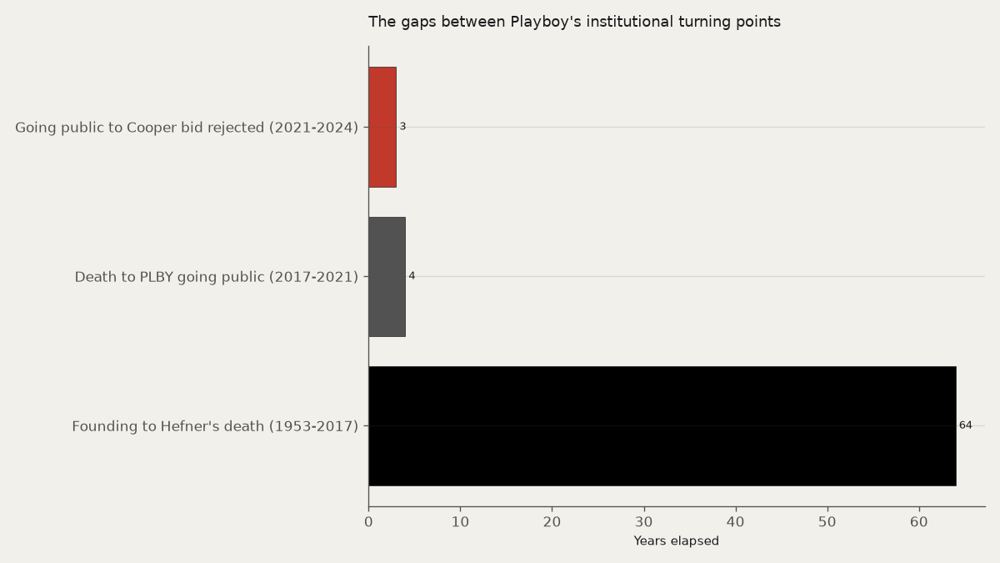
Hugh Hefner founded Playboy in 1953 and spent the next six decades turning it into three overlapping products: a magazine, a nightlife brand, and, by the end, a mansion that functioned as the physical showroom for all of it. Hefner died in 2017. PLBY Group, the public company that now owns the Playboy name, went public via SPAC merger in February 2021 and has run the brand since as a licensing operation — a name and a rabbit-head mark rented out across merchandise, experiences, and a relaunched magazine in what investor materials describe as roughly 180 countries. Read against each other, the four dates on this timeline compress seventy-one years into three transitions: six decades building a founder-fused hospitality brand, then a four-year gap between Hefner's death and the company's SPAC listing, then three more years before the board had to decide, in public, what kind of company it actually was.
1953
the year Hugh Hefner founded Playboy magazine
2017
the year Hugh Hefner died
2021
the year PLBY Group went public via SPAC merger
The Founder Problem: When the CEO Was the Catalog
Brands that fuse founder and product face a specific kind of balance-sheet exposure that ordinary consumer brands do not: the company cannot simply "rebrand the CEO" when the CEO was, for decades, the catalog itself. Hugh Hefner's late-life reputation has become part of the mark's baggage rather than an asset the company can still activate — he is not available to appear, endorse, or update the brand's meaning. PLBY Group's licensing thesis is, in effect, an attempt to keep the commercial value of the mark — the name, the bunny, the built-up recognition in roughly 180 countries — while distancing the operating business from the household that originally generated it.
The $100 Million Legacy Bid
In 2024, Cooper Hefner made a cash-plus-equity offer reported at more than $100 million, framed publicly as an attempt to reacquire the family's legacy assets. The PLBY board rejected the offer, stating it undervalued the company's assets under the continuing licensing model — Variety's reporting on the bid is the primary account of both the offer and the board's stated reasoning. The conflict at the center of that rejection is the chapter hinge of this report: heritage nostalgia, the framing behind Cooper Hefner's bid, against an asset-light profit-and-loss model built on licensing a mark whose living, personal referent is no longer available to the business. The board's decision did not resolve that tension philosophically. It resolved it commercially, in a single dated boardroom vote, in the company's favor as a licensing operation rather than as a returned family heirloom.
A Gag That Outlived the Product
One small, dated fact shows how long the mansion myth kept circulating in mainstream culture after the hospitality product itself had peaked. In Illumination's animated film Hop, released in 2011, Russell Brand voiced the lead rabbit character E.B., in a plot that includes a stylized Playboy Mansion-style setting; Hugh Hefner voiced a cameo role in the same film. This is a children's-film voice-cast credit, not a claim about anyone's conduct, and it is cited here strictly as cultural sediment — evidence that the Playboy Mansion, as an idea, had enough mainstream recognition in 2011 to work as a family-movie reference point, years before the founder's death and a decade before the company became a public licensing shell.
CONCLUSION
Playboy's founder built a brand where the product and the person were, for most of its history, difficult to separate. The 2024 rejection of Cooper Hefner's $100 million-plus bid is a modest but legible answer to what survives a founder like that: not the household, and not a family-run return to the mansion era, but a licensed mark the current business believes is worth more running as a licensing operation than handed back as legacy. Whether that mark keeps clearing in roughly 180 countries without a living founder attached to it is a question this single decision does not settle — it only shows what the board decided it was worth betting on in 2024.
■ END
The Fine PrintBack of the BoxEnd Credits
NoteWarningsDisclaimer
Artometrics data brief. Figures come from the sources below. Derived shares and editorial indices are not audited financials.
SourcesContentsSources
- SourcePLBY Group. Investor relations materials, including company descriptions of licensing footprint and brand history.
- SourceVariety. Reporting on Cooper Hefner's rejected bid to reacquire Playboy legacy assets, 2024.
- SourceHop (2011), Illumination Entertainment. Cast credits, including Russell Brand as E.B. and Hugh Hefner's cameo voice role.
- ReportFull report: artometrics.com/playboy
MethodAssemblyMethod
Numbers in this issue are the published figures. The skin changes type, rules, and chart color only.
PlatesMade byImage credits
- HeroArtometrics Playboy illustration.
- PlatePortrait of Luca Pacioli, attributed to Jacopo de' Barbari, c. 1495. Public domain, via Wikimedia Commons.
- PlateColor print of a toy shop, Utagawa Sadahide, 1860. The Metropolitan Museum of Art, CC0, via Wikimedia Commons.
- PlateBelasco Theatre box office, published November 1907 in Architects' and Builders' Magazine. Unknown photographer. Public domain, via Wikimedia Commons.


Updated through SEP 22, 2026.