
MAY 6, 2026 · Pokémon
Pokémon
Dragon-types Earn Their Attack Stats—Bug-types Don't Recover
Game Freak's type system encodes stat tradeoffs, power creep clusters at the tail, and Cosmoem weighs 999.9 kg at 0.1 meters.
By Kyle McAuliffe · · 5 min
Dragon-types post a median Attack of 100 and no stat below 80. Bug-types sit at 60 across the board. The difference isn't lore — it's the stat schema Game Freak has enforced across 949 Pokémon and nine generations. The franchise looks like a cultural phenomenon. The PokéAPI-derived TidyTuesday dataset shows it's a design system with measurable rules, deliberate specialists, and power creep that concentrates in the tail rather than the median.
100
Median Attack for Dragon-types, the stat-elite generalist with no weakness below 80
60
Bug-types' median across all six stats, the lowest-tuned primary type in the dataset
116
Steel-types' median Defense, the single highest stat cell on the heatmap
Stat Identity By Type
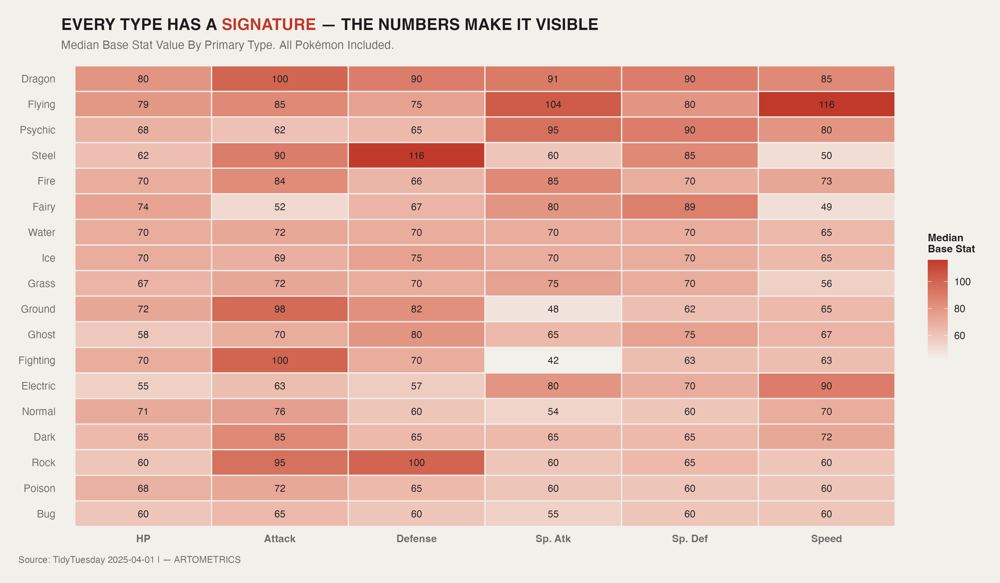
Dragon sits at the top of the heatmap for a reason. With a median Attack of 100 and no single stat below 80, Dragon-types are the closest thing Pokémon has to a generalist elite — high across the board, weak nowhere. The type wasn't always rare by accident. Game Freak made Dragon deliberately difficult to access in the early games because the numbers justified the gatekeeping. The more revealing story is in the specialists. Steel-types clock a median Defense of 116 — the highest single cell on the entire chart — while their Special Attack sits at 60, dead last among Steel's own stats. Fighting-types mirror that tradeoff on offense: Attack of 100, Special Attack of 42, the sharpest stat gap in the dataset. These aren't balanced Pokémon. They're designed to do one thing extremely well and pay for it everywhere else. The heatmap makes that design philosophy impossible to ignore. Bug sits alone at the bottom. Across all six stats, Bug-types post the lowest or near-lowest medians in every column — 60 HP, 65 Attack, 60 Defense, 55 Special Attack, 60 Special Defense, 60 Speed. The type has been statistically undertuned since Generation I and the data across nine generations confirms it hasn't been corrected. Whether that's a deliberate choice to keep early-game Pokémon weak or an oversight that calcified into canon, the result is the same: Bug-types are the worst-statted primary type in the game by a significant margin. One caveat: Flying appears near the top of the chart with an unusually high Speed median of 116, but Flying is almost never a primary type — it's almost always secondary. The dataset's primary Flying entries (Tornadus, Gyarados, Chatot, and a handful of others) are a small and unrepresentative sample, which inflates the type's apparent standing relative to how Flying Pokémon actually play in practice.
Generation Creep
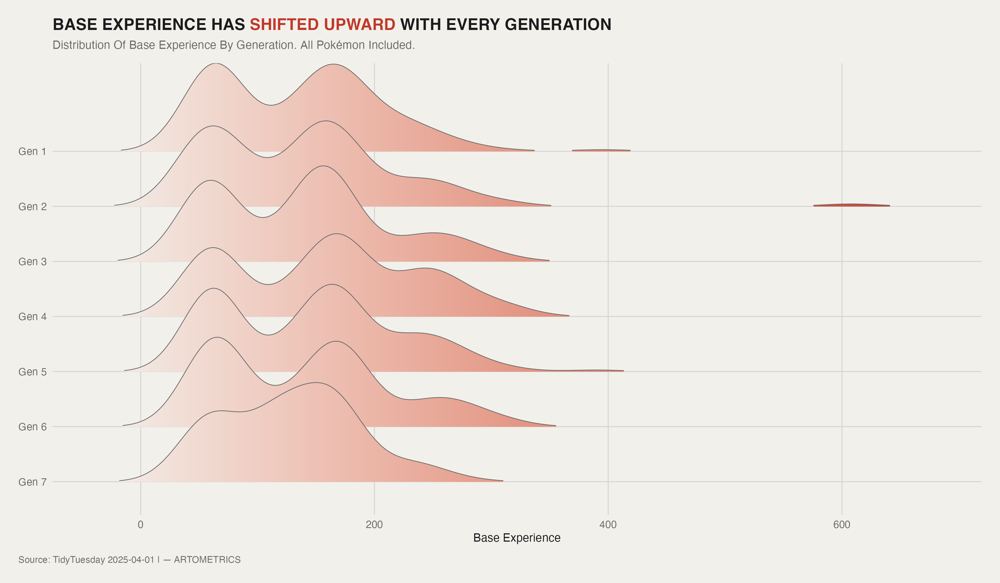
Every generation from Gen 1 through Gen 7 shows the same basic distribution shape — a peak around 60–70 base experience on the left, a second hump around 150–170 for mid-tier Pokémon, and a long tail trailing off toward the high end. What changes is that tail. With each successive generation, it stretches a little further right. The center of mass isn't dramatically shifting, but the ceiling keeps rising. The outliers tell the real story. That thin red thread extending past 600 on Gen 2's row is Blissey — a Normal-type with 255 base HP and the highest base experience yield of any Pokémon in the game at the time of its introduction. Gen 1 has its own isolated tail around 400, anchored by Chansey and the original legendary trio. These aren't flukes of the distribution — they're intentional design decisions that show up as statistical anomalies. Game Freak wasn't inflating power evenly across all Pokémon. They were adding extreme outliers at the top end while keeping the median relatively stable. Gen 7's distribution is the most compressed of any generation — the narrowest spread, the sharpest peak, the least variance. That's partly a function of Game Freak introducing fewer fully-evolved Pokémon with extreme stat totals in Alola, and partly a reflection of a design era that prioritized Mega Evolutions and Z-Moves over raw base stat inflation. The shape of Gen 7's curve is what controlled power creep looks like. Whether Game Freak intended it or stumbled into it, the ridgeline is the evidence.
■ END
The Fine PrintBack of the BoxEnd Credits
NoteWarningsDisclaimer
Artometrics data brief. Figures come from the sources below. Derived shares and editorial indices are not audited financials.
SourcesContentsSources
- SourceThe PokéAPI/TidyTuesday file is useful because it exposes the game-design schema behind the franchise: types, stats, generation IDs, dimensions, and battle-related mechanics in a machine-readable form. It is less useful for competitive o…
- SourceThe historical anchors are Satoshi Tajiri, Game Freak, Nintendo, Creatures, and The Pokémon Company because the numbers emerge from a designed commercial system that began with Pocket Monsters Red and Green in 1996. Bulbapedia and PokéAP…
- SourceData Science Learning Community. (2025). TidyTuesday: A weekly social data project. Week 13, 2025 — Pokémon. https://tidytues.day
- SourceIto, S. (Producer), & Tajiri, S. (Director). (1996). Pocket Monsters Red and Green [Video game]. Nintendo / Game Freak.
- SourcePokéAPI. (2025). The RESTful Pokémon API. https://pokeapi.co
- SourceBulbapedia contributors. (2025). Base experience. Bulbapedia, the community-driven Pokémon encyclopedia. https://bulbapedia.bulbagarden.net/wiki/Base_experience
- ReportFull report: artometrics.com/pokemon
MethodAssemblyMethod
Numbers in this issue are the published figures. The skin changes type, rules, and chart color only.
PlatesMade byImage credits
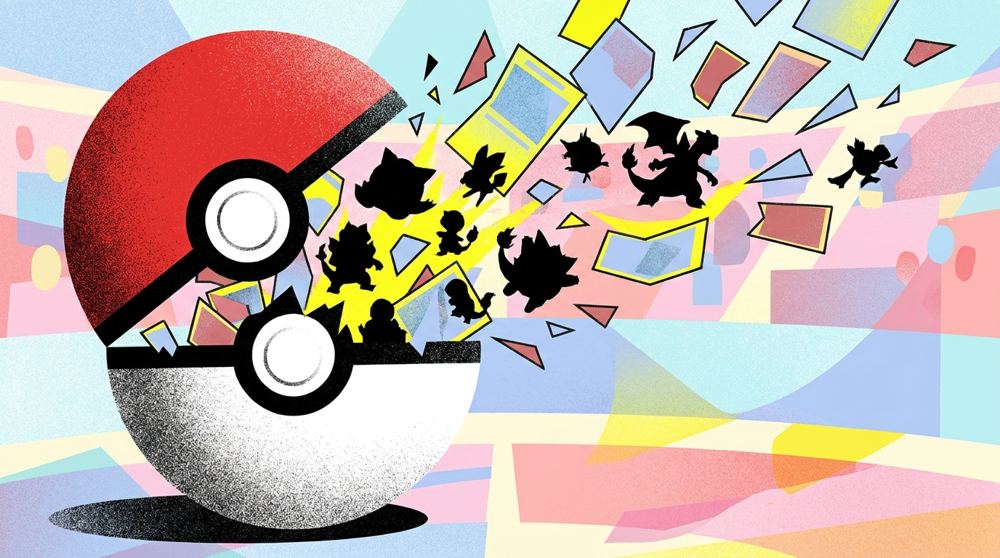
- HeroArtometrics Pokémon illustration.
- PlatePortrait of Luca Pacioli, attributed to Jacopo de' Barbari, c. 1495. Public domain, via Wikimedia Commons.
- PlateColor print of a toy shop, Utagawa Sadahide, 1860. The Metropolitan Museum of Art, CC0, via Wikimedia Commons.
- PlateBelasco Theatre box office, published November 1907 in Architects' and Builders' Magazine. Unknown photographer. Public domain, via Wikimedia Commons.


Updated through MAY 6, 2026.