
JUN 15, 2026 · Radio
Radio
News/Talk Lives on AM While FM Clusters at 101 MHz
17,186 station records show Country owns format share while News/Talk owns the upper AM band — frequency and culture answer different questions.
By Kyle McAuliffe · · 4 min
17,186 U.S. radio station records from TidyTuesday's 2022-11-08 release show a median frequency of 101 MHz, a high of 1,700 kHz on AM, and Country as the most common format — yet News/Talk stations sit 1,039 kHz above the median because of their historic AM placement.
The station license table is a spectrum map, not a ratings book. Call sign WEUP leads the frequency ranking, Country leads format share, and the top five call signs account for 34% of aggregate frequency — a concentration artifact that reflects dial extremes rather than audience consolidation.
Frequency and format answer different questions: one measures where stations sit on the electromagnetic spectrum, the other describes what they broadcast.
17,186
Station records in the dataset — full U.S. license snapshot from TidyTuesday 2022-11-08
101 MHz
Median frequency — FM center of gravity for the working file
1,039 kHz
News/Talk elevation above median — heavy AM presence pulls the format into a different band
Frequency by call sign
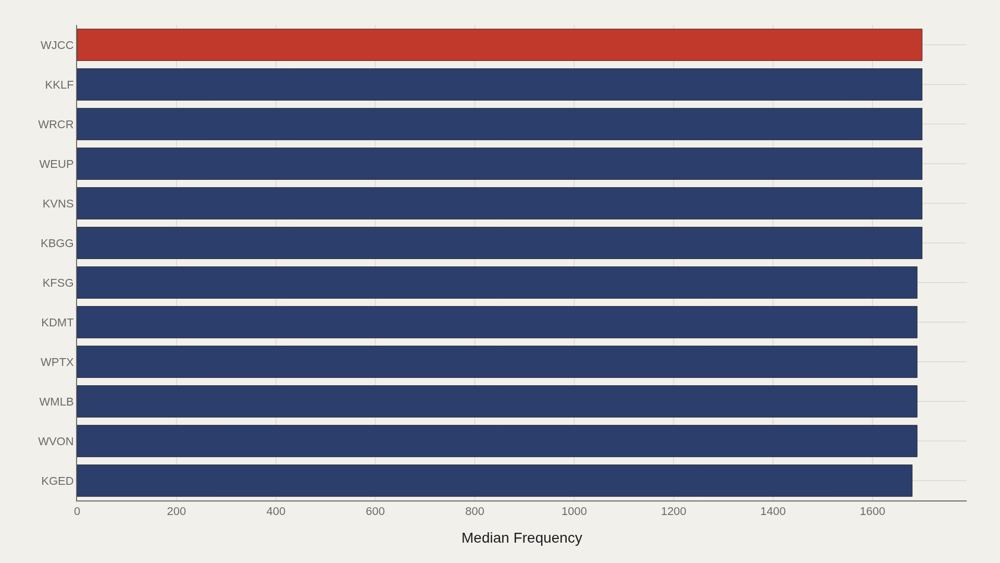
WJCC appears near 1,700 kHz at the high end of the call-sign frequency cut, with neighbors such as KGED near 1,680 kHz. These are upper-AM coordinates, not audience-size claims. Grouping by call sign exposes how the metric varies across licensed identities — a map of where stations sit on the spectrum, not which morning shows win their cities.
Who sits at the top
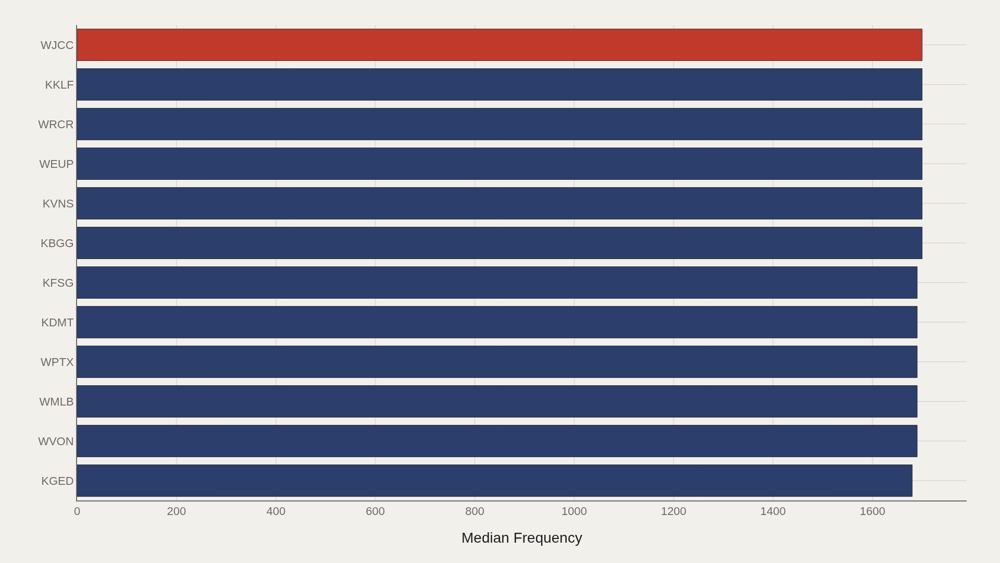
WJCC leads at 1,700 kHz, with 1,695 kHz as the median among the top dozen. The entire top band is a tight cluster of high-AM assignments. The finding is the tightness itself: the top of frequency is a narrow technical neighborhood, while format diversity lives on a different axis.
Frequency by format
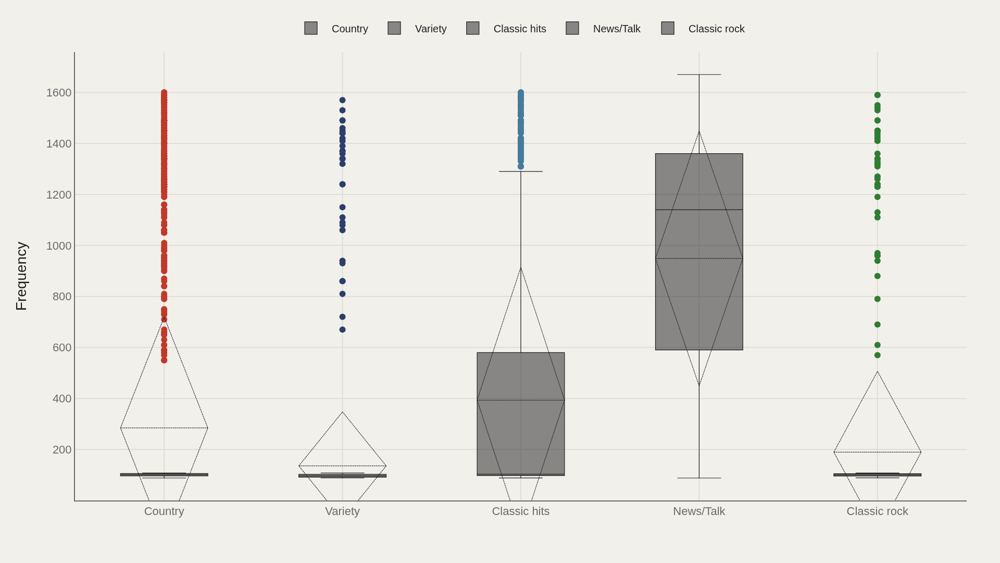
Box plots by format — Country, News/Talk, Sports, Classic Hits, and related labels — show whether frequency consensus is shared or contested across programming types. Country leads station count but does not automatically own the highest dial positions. Format is culture; frequency is spectrum. Confusing the two produces false stories about which genres rule the airwaves.
Who beats the median — and who trails
News/Talk sits 1,039 kHz above the median; Contemporary Christian trails by about 9. News/Talk's elevation reflects its heavy presence on AM frequencies far above the FM-centered median of 101 MHz. The gap is a band-plan story as much as a format story. Talk radio's historic AM home pulls its frequency distribution into a different universe from music formats clustered on FM.
Concentration on the dial
The top five call-sign entries account for 34% of aggregate frequency in the working cut — a concentration statistic that reflects how large the highest dial numbers are relative to the median, not a claim that five stations own a third of listening. Summing dial positions is not the same as summing audiences. Pareto-on-frequency is a reminder that spectrum physics and market share are separate metrics.
What to take away
The U.S. radio dial in this file centers at 101 MHz with AM extremes near 1,700 kHz, Country as the most common format, and News/Talk pulled high by AM band placement.
The citable split is spectrum versus culture: call-sign frequency leaders and format share leaders answer different questions about the same airwaves.
■ END
The Fine PrintBack of the BoxEnd Credits
NoteWarningsDisclaimer
Artometrics data brief. Figures come from the sources below. Derived shares and editorial indices are not audited financials.
SourcesContentsSources
- SourceThe source is the TidyTuesday release from 2022-11-08, maintained by the R for Data Science community. The working file contains 17,186 rows and 11 columns after cleaning — call signs, frequencies, formats, and license status fields.
- ReportFull report: artometrics.com/radio
MethodAssemblyMethod
Numbers in this issue are the published figures. The skin changes type, rules, and chart color only.
PlatesMade byImage credits
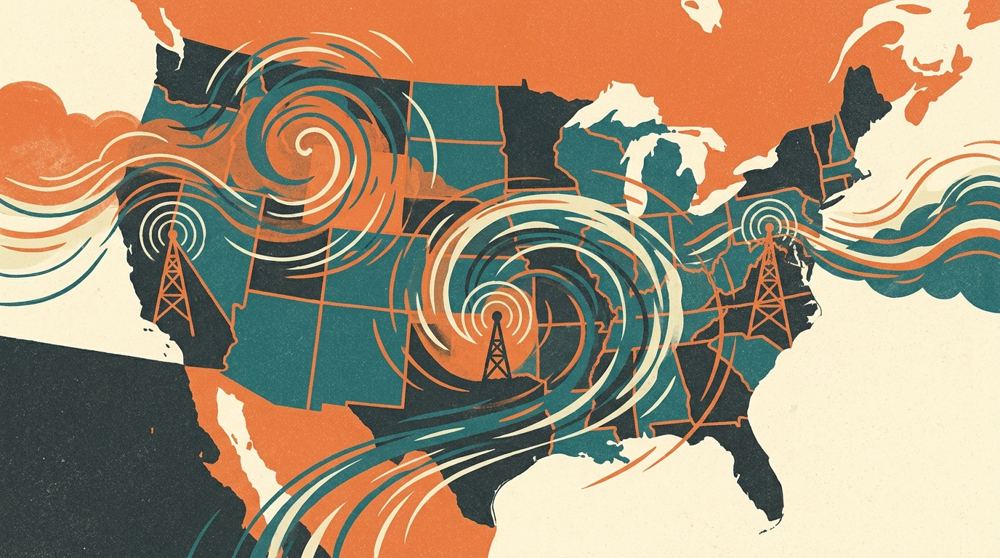
- HeroArtometrics Radio illustration.
- PlatePortrait of Luca Pacioli, attributed to Jacopo de' Barbari, c. 1495. Public domain, via Wikimedia Commons.
- PlateColor print of a toy shop, Utagawa Sadahide, 1860. The Metropolitan Museum of Art, CC0, via Wikimedia Commons.
- PlateBelasco Theatre box office, published November 1907 in Architects' and Builders' Magazine. Unknown photographer. Public domain, via Wikimedia Commons.


Updated through JUN 15, 2026.