

JUN 15, 2026 · Ramen
Ramen
Malaysia Leads Global Ramen Ratings by Half a Star
3,180 instant-ramen reviews show a 5.00-star ceiling and country gaps of 0.25–0.50 stars around the 3.75 median.
By Kyle McAuliffe · · 4 min
The median instant-ramen rating in a 3,180-record TidyTuesday sample is 3.75 stars on a five-point scale, but dozens of brands share the 5.00 ceiling — compressing the top into a plateau where Malaysia's 0.50-star lead above the median becomes the most meaningful country gap.
Star ratings collapse broth clarity, noodle chew, spice balance, and packaging nostalgia into a single number. A TidyTuesday working file from June 2019 shows 3,180 reviews with a median of 3.75 and a maximum of 5.00. Nongshim leads the brand ranking in the fact box, and Japan is the most common country label by product count — though output volume and rating leadership do not align.
When perfect scores are common, the useful story lives below the ceiling: which countries sit above the median, and whether high ratings rest on thin or thick review support.
3.75
Median stars across 3,180 reviews — half of all ratings fall at or above this threshold
5.00
Ceiling shared by TTL, Tseng Noodles, A-Sha, Prima Taste, and a dozen other perfect-score brands
0.50
Malaysia's lead above the median — the largest positive country gap in the dataset
Stars by brand
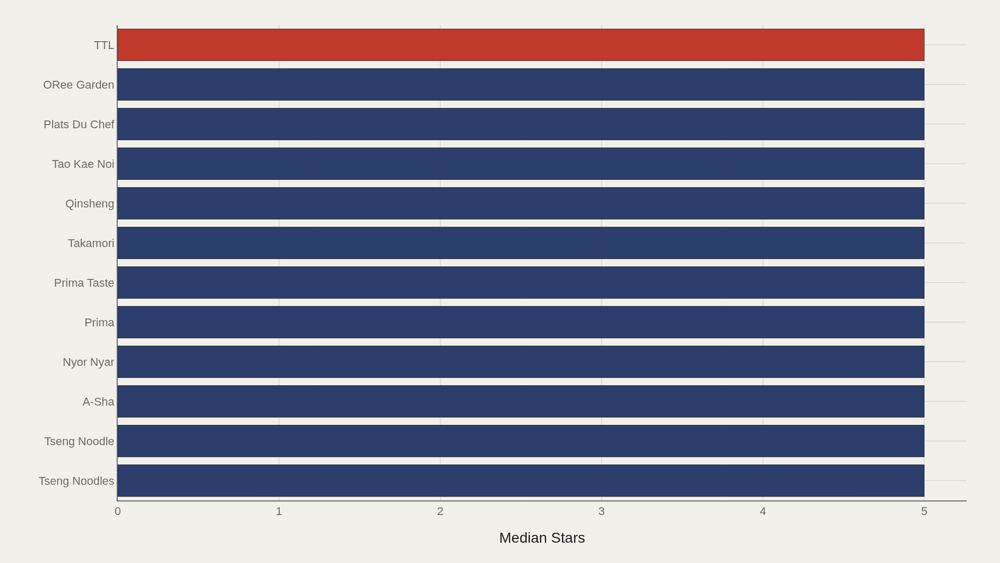
Brand rollups at the top of the chart crowd the 5.00 ceiling. TTL, Tseng Noodles, A-Sha, Prima Taste, and other specialists occupy the perfect-score band. When the top saturates, discrimination shifts to consistency across varieties and the number of reviews behind the mean. Nongshim's fact-box lead can coexist with a chart full of smaller perfect-score brands because aggregation choices — mean across varieties, review weighting, or maximum score — change the ranking order.
Who sits at the top
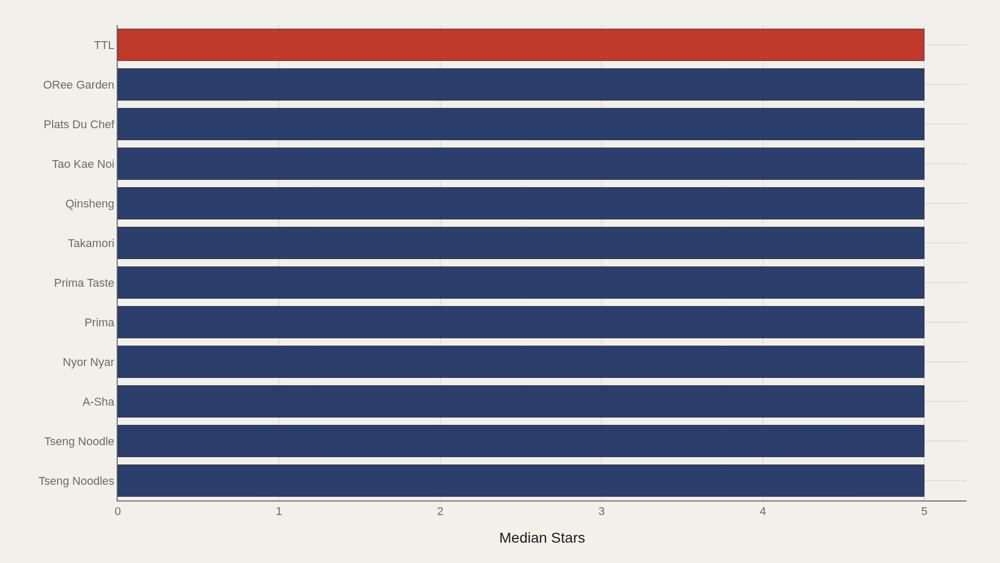
TTL leads at 5.00, and the median among the top dozen is also 5.00. The elite band is a plateau, not a ladder. Perfect scores are common enough that first place is a crowded room. Tiny rank differences among five-star brands carry little information. The useful comparisons appear in the middle of the distribution and across countries.
Stars by country
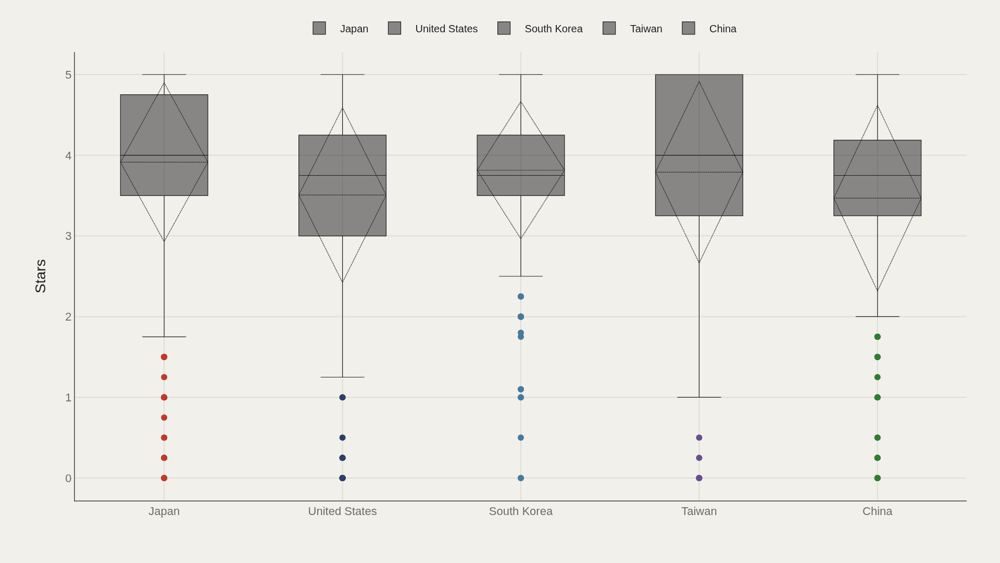
Country box plots show whether star consensus is shared or contested across producing nations. Japan leads by product count; Malaysia, Thailand, South Korea, and Singapore compete on rating location rather than volume. A country can dominate shelf presence without dominating the upper quartile of stars. The spread chart separates industrial scale from taste prestige.
Who beats the median — and who trails
Malaysia sits 0.50 stars above the median; Thailand trails by 0.25. Those gaps look small until you remember the scale runs to 5.00 and the median is already 3.75. Half a star above center is a material national reputation effect in a compressed rating system. It is also narrow enough that a few legendary varieties can move a country's summary.
Stars and review number
Plotting stars against review number reveals clusters that averages hide. Some high-rated varieties have thin review support; some heavily reviewed products sit nearer the middle. Attention and admiration are related, not identical. Review-number fields in the source can behave as identifiers as much as popularity counts. The scatter prevents readers from equating a perfect score with a broadly tested consensus.
What to take away
Instant ramen ratings in this file center near 3.75 stars, with a crowded perfect-score ceiling at 5.00 and country gaps of 0.25 to 0.50 stars around the median.
When the top is a plateau of five-star brands, the meaningful geography is which countries sit above the middle and how much review support stands behind the praise. Malaysia's 0.50-star lead and Thailand's 0.25-star deficit matter more than first-place ties at the ceiling.
■ END
The Fine PrintBack of the BoxEnd Credits
NoteWarningsDisclaimer
Artometrics data brief. Figures come from the sources below. Derived shares and editorial indices are not audited financials.
SourcesContentsSources
- SourceThe source is the TidyTuesday release from 2019-06-04, maintained by the R for Data Science community. The working file contains 3,180 rows and six columns after cleaning: brand, variety, style, country, stars, and review number.
- ReportFull report: artometrics.com/ramen
MethodAssemblyMethod
Numbers in this issue are the published figures. The skin changes type, rules, and chart color only.
PlatesMade byImage credits
- HeroArtometrics Ramen illustration.
- PlatePortrait of Luca Pacioli, attributed to Jacopo de' Barbari, c. 1495. Public domain, via Wikimedia Commons.
- PlateColor print of a toy shop, Utagawa Sadahide, 1860. The Metropolitan Museum of Art, CC0, via Wikimedia Commons.
- PlateBelasco Theatre box office, published November 1907 in Architects' and Builders' Magazine. Unknown photographer. Public domain, via Wikimedia Commons.


Updated through JUN 15, 2026.