
JUL 28, 2026 · Trademarks
Trademarks
A ¥10.3 Million Win Becomes Cultural Reckoning
Louis Vuitton won ¥10.3 million against Molly Tea in Suzhou court on 29 June 2026 for four-petal logo infringement. Chinese social media reframed the first-to-file trademark case as foreign enclosure of Tang-era motifs.
By Kyle McAuliffe · · 5 min
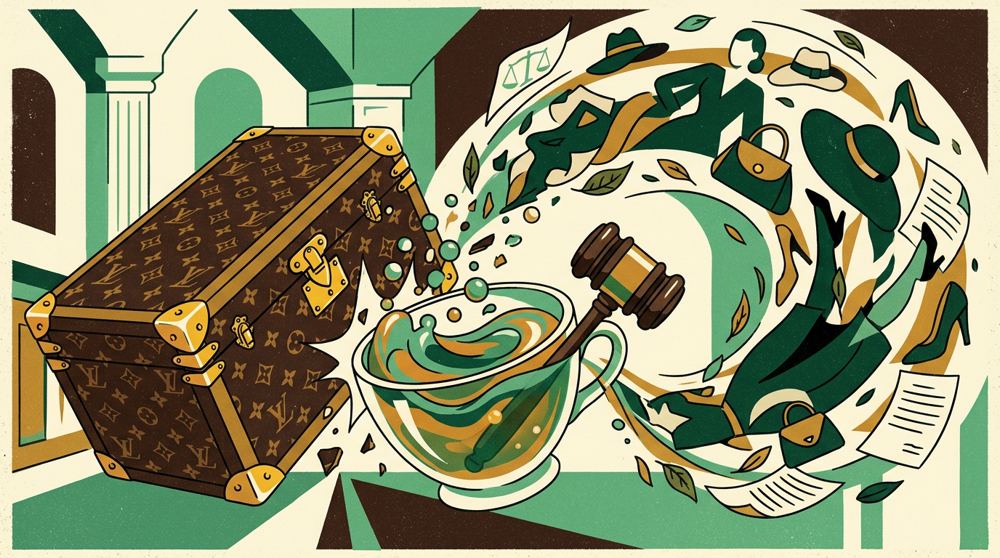
A Suzhou trademark judgment awarded Louis Vuitton ¥10.3 million against a domestic tea chain. Chinese social media turned the ruling into a morality play about cultural theft. The court record is narrower: Louis Vuitton Malletier sued Shenzhen Molly Tea over a four-petal floral device used in brand identity, the first-instance court found infringement of seven registered marks, and Molly Tea announced an appeal.
This report separates what the judgment and CNIPA history show, how the case fits Louis Vuitton's broader China enforcement pattern, and why a legally ordinary win became a cultural-economy event.
¥10.3M
First-instance damages and costs awarded to Louis Vuitton; judgment is not final
~1,691
LV trademark-infringement records in China over five years (media-cited Qichacha tally)
7
Four-petal flower trademarks held infringed by the Suzhou court
What the court actually ordered
The first-instance order requires Shenzhen Molly Tea to cease infringing use of the disputed four-petal device, pay ¥10 million in economic damages and ¥300,000 in reasonable enforcement costs, and publish corrective statements on six surfaces: official website, Weibo, WeChat Official Account, WeChat Mini Program, Xiaohongshu, and Douyin. A franchise defendant was described as jointly liable up to ¥100,000. Molly Tea publicly announced an appeal.
Two procedural facts matter. First, Molly Tea had tried to register a four-petal logo; CNIPA refused application no. 81049590 (Class 43), citing prior LV flower marks, and the refusal review became final. Second, the court's association logic sits in a market where luxury–FMCG collaborations are common — so "nobody confuses a handbag with milk tea" misses the legal question, which was whether the logo could suggest sponsorship or commercial linkage.
A larger litigation machine
Chinese coverage places Molly Tea inside a multi-year Louis Vuitton enforcement campaign: approximately 1,691 trademark-infringement records over five years, with 56 new filings reported in the first half of 2026. Recoveries across many matters are described as modest relative to global luxury revenue — deterrence and anti-dilution, not a profit center.
That context cuts both ways. It undercuts the idea that Molly Tea was a one-off bullying novelty: LV litigates flower-device conflicts as portfolio practice. It also explains why the public read this case as the tip of a pattern — especially when parallel administrative fights with CNIPA and other small defendants entered the same news cycle. Comparative China brand fights (for example, long-running New Balance mark disputes or the Dior / mamianqun controversy) show the same structural tension: first-to-file commercial exclusivity versus popular claims about shared cultural forms.
Resemblance is not provenance
Xiaohongshu and state-media posts placed LV's four-petal monogram flower beside Tang-dynasty decoration — rosewood pipa inlay and quatrefoil window lattice in classical gardens such as Suzhou's Humble Administrator's Garden. Historians describe baoxiang motifs as composite ornamental vocabularies drawn from lotus, peony, and related flora. Persimmon-calyx geometry is another folk visual rhyme circulating in the same threads.
Those comparisons establish visual kinship in a shared decorative commons. They do not cancel a registered commercial graphic under China's Trademark Law. LV's own origin story for the 1896 Monogram, as relayed in LVMH materials and wire reporting, cites neo-gothic ornament and Japonism — not a court finding that the mark is a Tang-era replica.
Secondary-market signal, not a balance sheet
Chinese secondary-market coverage after the judgment described quieter boutiques and softer ask prices — for example, a Carryall small near ¥19,000 new on Dewu against ~¥23,000 retail, and deeper discounts on used Neverfull and Onthego units. Dealers also described a surge of sellers. That is a real market mood.
Two frames, same facts
In the court frame, registered rights, CNIPA prior refusal, and association risk dominate. In the public frame, Tang resemblance, nationalist brand optics, and "foreign giant vs domestic chain" narrative dominate. East Is Read's media monitoring put related posts in the hundreds of thousands with Weibo topic pages in the hundreds of millions of views — order-of-magnitude attention, not legal error.
Conclusion
Molly Tea is a first-instance trademark defendant ordered to pay ¥10.3 million and apologize on six platforms; the case is on appeal. Louis Vuitton's legal theory sits inside a large China enforcement machine. The internet's theory sits inside a longer argument about who may exclusively commercialize motifs that also live in Chinese decorative history. The viral Shorts are a map of popular feeling, not a substitute for the docket.
■ END
The Fine PrintBack of the BoxEnd Credits
NoteWarningsDisclaimer
Artometrics data brief. Figures come from the sources below. Derived shares and editorial indices are not audited financials.
SourcesContentsSources
- SourceAP News — "Louis Vuitton court victory against Chinese tea chain stirs up a copyright debate" (2026). apnews.com
- SourceChina IP Law Update — "Louis Vuitton Scores 10 Million RMB in a Controversial Trademark Infringement Dispute Against Molly Tea" (July 2026). chinaiplawupdate.com
- SourceD'Andrea & Partners — "Louis Vuitton v. Molly Tea: Chinese Court Rules on Trademark Infringement in the Beverage Sector." dandreapartners.com
- SourceChina Briefing — "Trademark Protection in China: Legal Victory Is Only Part of the Strategy." china-briefing.com
- SourceGlobal Times — "LV vs Molly Tea case exposes modern IP's cultural blind spot." globaltimes.cn
- SourceJiemian / Xinhua / Southern Metropolis secondary reporting on judgment date, appeal statements, and damages.
- SourceArtometrics ethics — evidence tiers.
- ReportFull report: artometrics.com/trademarks
MethodAssemblyMethod
Numbers in this issue are the published figures. The skin changes type, rules, and chart color only.
PlatesMade byImage credits
- HeroArtometrics Trademarks illustration.
- PlatePortrait of Luca Pacioli, attributed to Jacopo de' Barbari, c. 1495. Public domain, via Wikimedia Commons.
- PlateColor print of a toy shop, Utagawa Sadahide, 1860. The Metropolitan Museum of Art, CC0, via Wikimedia Commons.
- PlateBelasco Theatre box office, published November 1907 in Architects' and Builders' Magazine. Unknown photographer. Public domain, via Wikimedia Commons.


Updated through JUL 28, 2026.