
JUN 15, 2026 · Wine
Wine
Austria and Chile, Two Points Apart
Austria leads Chile by 2.00 points; the median sits at 88.0 in a dataset where the top dozen titles all score 100.
By Kyle McAuliffe · · 3 min

100,000 wine ratings from the TidyTuesday archive show a median score of 88.0, a perfect-score ceiling among elite titles, and Austria leading Chile by 2.00 points. The points–price scatter reveals clusters that averages erase: cheap high scorers, expensive middling bottles, and a familiar cloud where spending more often accompanies higher scores without guaranteeing them.
The calibration point is 88.0 — the mathematical center of a scoring culture that uses the high end of the scale and leaves the bottom half empty.
100,000
Records — enough to test whether price predicts points across countries and titles
88.0
Median score — the mathematical center of a compressed rating scale
2.00
Austria's lead over Chile — a small gap in a system that clusters in the high 80s
Perfect scores crowd the title breakdown's top slice
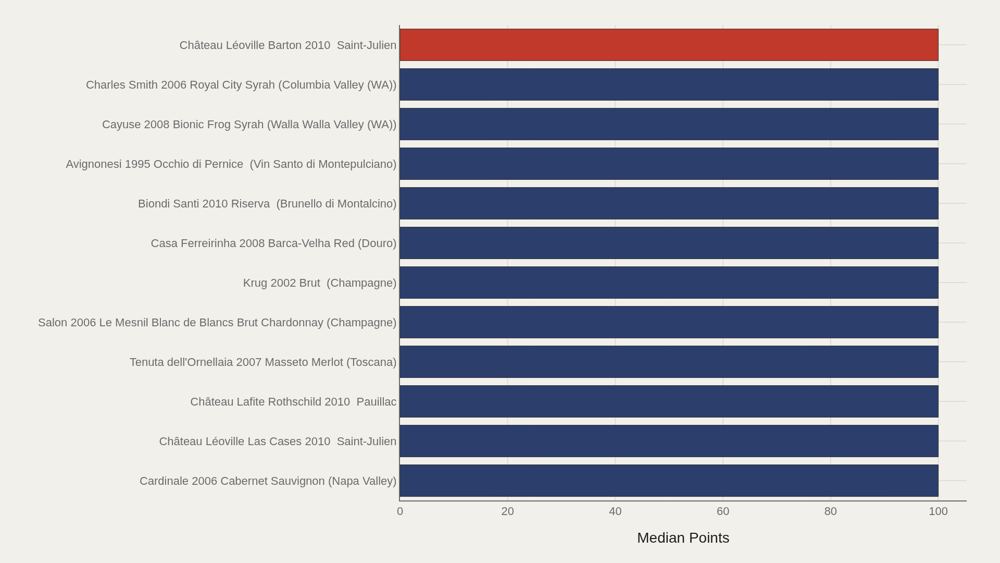
Château Léoville Barton 2010 Saint-Julien leads at 100; Cardinale 2006 Cabernet Sauvignon (Napa Valley) anchors the low end of the plotted top group at 100 — a flat elite band at the ceiling. When the top slice is all 100s, the chart shows saturation at the maximum, not a ladder of near-misses.
The leaders chart is a wall of 100-point wines
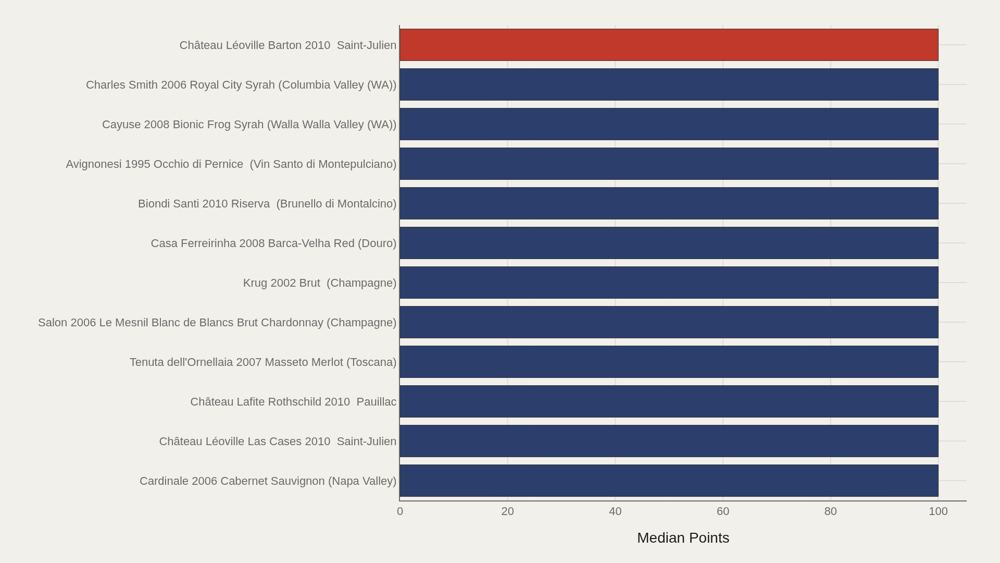
The top dozen's median is 100, not 95 or 97 — the elite is compressed at the ceiling. Charles Smith 2006 Royal City remains a fact-box landmark for the title ranking rule used there, but the wall of perfect scores is the structural signal.
Countries spread points around a high center
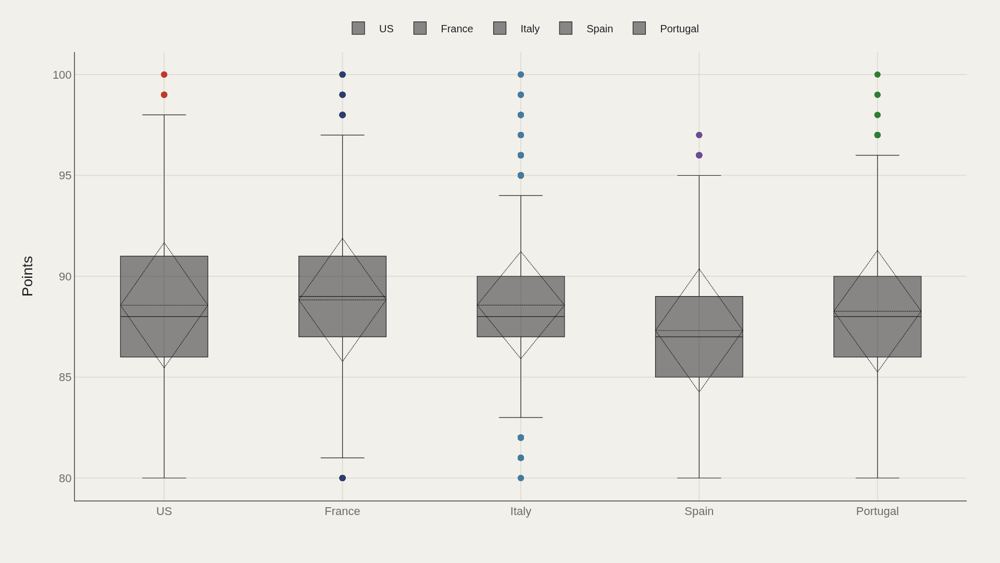
Category boxes by country show whether points consensus is shared or contested across origins. The United States is the most common country by frequency; the boxes test how much score variation place carries in this file.
Austria clears the median; Chile trails
Austria sits 2.00 points above the median; Chile trails by 2.00. Those signed gaps are modest in points terms — a reminder that this scoring culture lives in a narrow band around 88.0. Small gaps can still be meaningful when the whole scale's action happens between the high 80s and the low 90s for most bottles.
Points and price form the real test of the dinner-table theory
Plotting points against price shows clusters that averages erase: cheap high scorers, expensive middling bottles, and the familiar cloud where spending more often accompanies higher scores without guaranteeing them. The scatter is the relationship the title promised — it shows the joint distribution in the 100,000-row extract without claiming a coefficient beyond what the chart displays.
What to take away
Wine scores in this file center on a median of 88.0, peak at 100 among title leaders, and show only modest country gaps around that high center. Austria sits 2.00 points above the median and Chile 2.00 below, while the points–price scatter is where the cost-versus-score question becomes visible without reducing 100,000 tastings to a slogan.
■ END
The Fine PrintBack of the BoxEnd Credits
NoteWarningsDisclaimer
Artometrics data brief. Figures come from the sources below. Derived shares and editorial indices are not audited financials.
SourcesContentsSources
MethodAssemblyMethod
Numbers in this issue are the published figures. The skin changes type, rules, and chart color only.
PlatesMade byImage credits
- HeroArtometrics Wine illustration.
- PlatePortrait of Luca Pacioli, attributed to Jacopo de' Barbari, c. 1495. Public domain, via Wikimedia Commons.
- PlateColor print of a toy shop, Utagawa Sadahide, 1860. The Metropolitan Museum of Art, CC0, via Wikimedia Commons.
- PlateBelasco Theatre box office, published November 1907 in Architects' and Builders' Magazine. Unknown photographer. Public domain, via Wikimedia Commons.


Updated through JUN 15, 2026.