

Coffee · Updated through July 7, 2020
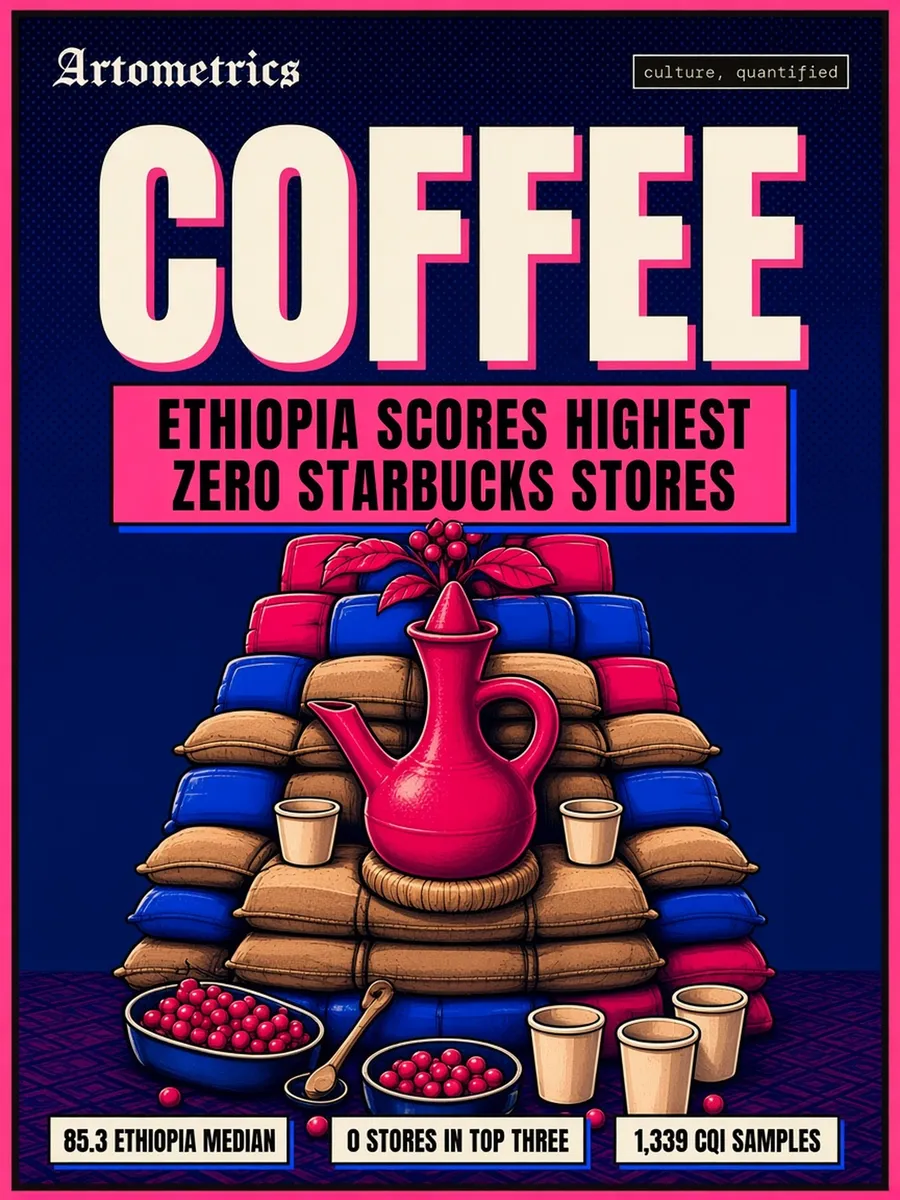
Ethiopia Scores Highest on Coffee Quality—With Zero Starbucks Stores
Everything behind this report in one place: the data files you can download, the resources we built from them, and each citation with its link.
Read the report Download primary data
Datasets
3 chart specifications (Plotly JSON)
Resources
Citations
- S1 The Coffee Quality Institute data should be read as a specialty-coffee evaluation archive, not a random sample of all coffee output. CQI Q Graders score submitted samples under standardized protocols, which means the file is strongest fo…no link yet
- S2 The broader citation frame comes from coffee-development and value-chain research by Daviron, Ponte, Samper, Quiñones-Ruiz, and the International Coffee Organization. Those sources matter because the charts show a classic commodity-chain…no link yet
- S3 TidyTuesday (2020-07-07). Coffee Ratings. R for Data Science Community. github.com/rfordatascience/tidytuesday/…/2020-07-07
- S4 TidyTuesday (2018-05-07). Coffee Chains. R for Data Science Community. github.com/rfordatascience/tidytuesday/…/2018-05-07
- S5 Coffee Quality Institute. (2020). Q Grader Program and Cupping Protocols. Retrieved from coffeeinstitute.org
- S6 Samper, L. F., & Quiñones-Ruiz, X. F. (2017). Towards a balanced sustainability vision for the coffee industry. Resources, 6(2), 17. doi.org/10.3390/resources6020017
- S7 Daviron, B., & Ponte, S. (2005). The Coffee Paradox: Global Markets, Commodity Trade and the Elusive Promise of Development. Zed Books.
- S8 Wintgens, J. N. (Ed.). (2009). Coffee: Growing, Processing, Sustainable Production (2nd ed.). Wiley-VCH.
Notes
- Updated through July 7, 2020.
- Citations keep the wording from the report's issue file. Links were not rewritten.