
MAR 31, 2026 · Anime
Anime
Source Sets the Audience Floor
On the October 2026 MyAnimeList ledger, light-novel TV adaptations still draw 27.5 times the median audience of originals. Source mix and isekai tags trace how committees greenlight shows — with wide uncertainty on any single year.
By Kyle McAuliffe · · 5 min

Death Note has 1,610,561 MyAnimeList members, more than any other anime in the archive, and scores 8.66. Hanada Shounen-shi, a 2002 series from the same studio, Madhouse, scores 8.11 and has 8,929. A MyAnimeList archive of 18,813 clean titles (October 2026 snapshot via Tenrai + AniList; see what changed when we fixed the data) suggests that much of a gap like that is set before anyone draws a frame, starting with where the story comes from.
27.5×
median members, light-novel TV vs original TV (196,258 vs 7,133)
14.8%
share of scored manga TV titles scoring 8.0 or higher (n = 1,980)
20.4%
isekai-tagged share among 2021 TV premieres (trend; 95% CI ~±5 pts)
Each format wave lines up with a new distribution channel
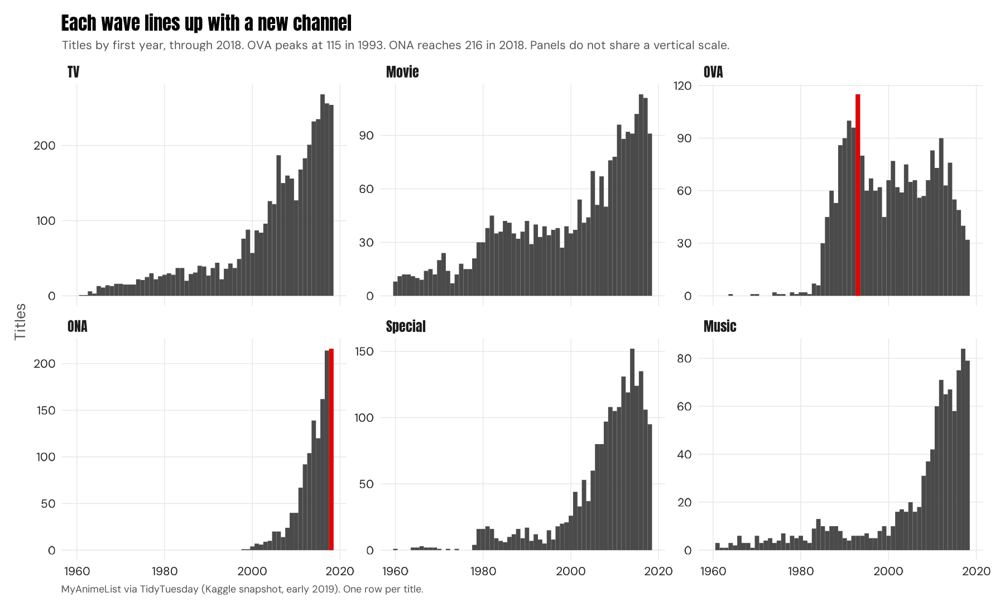
Anime output is not one growth curve. It's a series of format waves, and each wave lines up with a new channel. Theatrical film dominates the early catalog. Original video animation (OVA), sold directly on tape and disc, ran at roughly 100 titles a year from 1990 to 1993 and peaked at 115 in 1993. Television then became the core of the catalog, with 4,260 TV titles in the archive. Original net animation (ONA), made for web distribution first, grew from 40 titles in 2009 to 104 in 2013 and 216 in 2018, for 1,321 in total.
Source material sets the audience floor
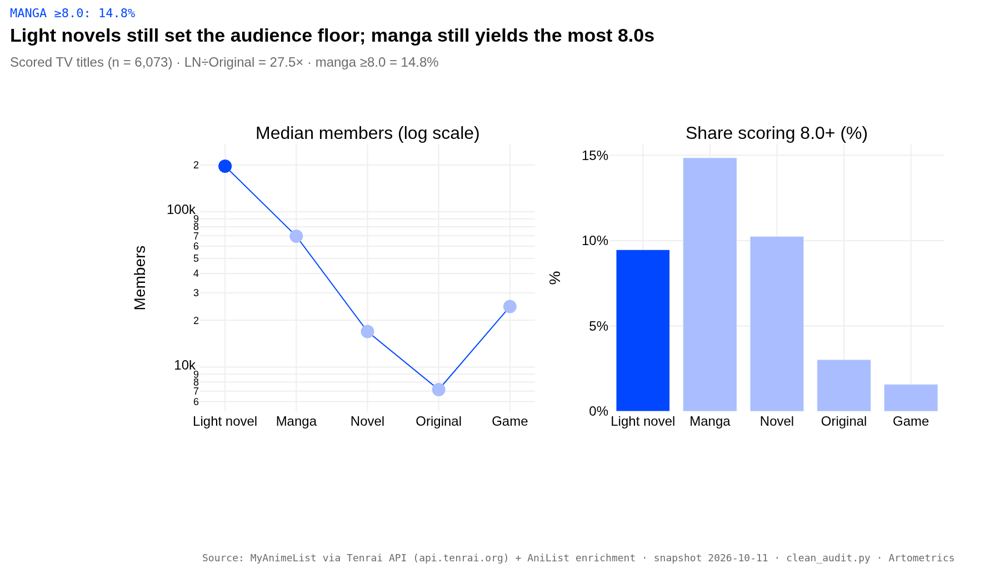
Some of the biggest shows on the site sit behind the 153,184 median. Sword Art Online (A-1 Pictures, 2012) has 1,442,099 members, the third-largest audience in the archive, yet it scores 7.58, which shows reach and rating moving apart. No Game No Life (Madhouse, 2014) and Toradora! (J.C.Staff, 2008) both pass a million members and both score 8.38. A typical adaptation is smaller: Mahou Sensou sits at exactly the median, with 153,184 members.
ISEKAI TAGS AND SOURCE MIX (2015–2025)
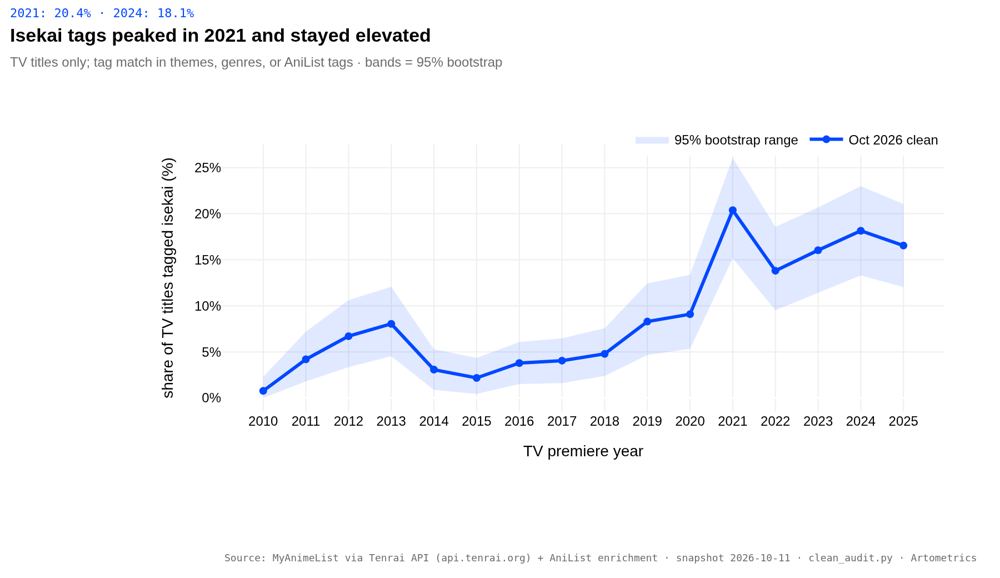
On the clean TV frame, isekai-tagged premieres were rare in the mid-2010s, rose to about 20.4% of 2021 TV titles, and remained elevated near 18.1% in 2024 — not a precise dip from the published 17.7% exploratory figure once uncertainty is applied. The 2015 point moves more materially, from 0.9% to 2.2%, because the refresh joins denser AniList tags to MAL theme fields.
Consistency is a studio trait
In a system where the committee owns the project, the animation studio is usually the prime contractor (motouke), and much of the drawing is subcontracted (shitauke) to other studios and freelancers (Hanzawa, 2004). Inside a studio, production managers (seisaku shinkou) coordinate the work but depend on key creatives, whose drawing skill routinely gives them the upper hand (Morisawa, 2015). That makes a studio's typical output a better guide to what a commission will deliver than its single biggest hit.
Sequels score higher, consistent with mostly well-received shows getting one
Of the 4,240 scored TV titles, 867 are sequels. We count a title as a sequel when its chain of prequels, every one of which aired earlier, reaches an earlier TV series. That rule keeps promotional specials from making a first season look like a sequel. Sequels have a median score of 6.99, against 6.76 for the other 3,373 titles, and 14.8% of them score 8.0 or higher (128 of 867), against 6.5% (218 of 3,373). The median gap ranges from 0.15 to 0.30 points depending on how "sequel" is defined, but every definition we tested points the same way.
Popularity tracks quality, with a short list of exceptions
Member counts are extremely skewed. A rank (Spearman) correlation gives 0.73 on the clean ledger, and correlating score with the log of member count gives a similar reading. On this platform, well-rated titles are usually well watched.
CONCLUSION: Choose the source, judge the studio by its median, and read sequel scores as property scores
The archive doesn't show what makes anime good. It does show where the industry's early decisions leave a mark. Adapting a light novel or manga brings an audience that is already there, while an original has to find one. Studios differ clearly in their typical output, which is the better guide to a commission. Sequel scores mostly reflect the shows that earned them. Beyond those patterns lies a short list of strong titles the platform's audience never found. The next useful question is commercial. Matching these fan signals to revenue data would show whether the platform's audience floor is also a revenue floor.
■ END
The Fine PrintBack of the BoxEnd Credits
NoteWarningsDisclaimer
Artometrics data brief. Figures come from the sources below. Derived shares and editorial indices are not audited financials.
SourcesContentsSources
- SourcePrimary data. MyAnimeList metadata via Tenrai API, snapshot 2026-10-11; baseline comparison TidyTuesday 2019-04-23. TidyTuesday 2019-04-23 · data/anime/METHODS_NOTE.md.
- SourceHernández Hernández, Á. D. (2018). "The Anime Industry, Networks of Participation, and Environments for the Management of Content in Japan." Arts 7(3): 42. Cited for §4.3 (pp. 8–9), the committee mechanism. doi:10.3390/arts7030042.
- SourceHanzawa, Seiji (2004). "The Japanese Animation and Home Video Game Industries." Japanese Journal of Human Geography 56(6): 587–602. Cited for subcontracting and freelance labor. doi:10.4200/jjhg1948.56.587.
- SourceMihara, Ryotaro (2018). "Involution: a perspective for understanding Japanese animation's domestic business in a global context." Japan Forum 32(1): 102–125. Published online 2018. doi:10.1080/09555803.2018.1442362.
- SourceMorisawa, Tomohiro (2015). "Managing the unmanageable: Emotional labour and creative hierarchy in the Japanese animation industry." Ethnography 16(2): 262–284. Cited only for the production-management layer (seisaku shinkou) that depends…
- SourceSteinberg, M. (2012). Anime's Media Mix: Franchising Toys and Characters in Japan. University of Minnesota Press. Cited for the media mix and for the television wave beginning with Tetsuwan Atom (1963) and sponsor merchandising.
- SourceCreamer, Nick (2015-12-02). "What Makes Kyoto Animation So Special?" Anime News Network. animenewsnetwork.com.
- SourceMoore, D. M. (2017-10-20). "A Silent Voice shows why Kyoto Animation is one of the top animation studios." The Verge. theverge.com.
- SourceKyoto Animation, training school. kyotoanimation.co.jp/school.
- SourceMorrissy, Kim (2018-12-12). "Looking Back on 20 Years of Studio Bones." Anime News Network. animenewsnetwork.com.
- SourceKyoto Animation, company outline. kyotoanimation.co.jp/company/outline. Hiring page. new-graduate animator terms.
- SourceOLM, company site. olm.co.jp/about. Anime News Network encyclopedia entry. animenewsnetwork.com.
- SourceToei Animation, company history. corp.toei-anim.co.jp.
- SourceDLE, company history. dle.jp/jp/company. Anime News Network (2020) on Eagle Talon. animenewsnetwork.com.
- SourceIDOLiSH7 official announcement (Jan 17, 2017). idolish7.com. Anime News Network (2017). animenewsnetwork.com.
- SourceNetflix Media Center, Devilman: Crybaby. media.netflix.com. Anime News Network (2017). animenewsnetwork.com.
- SourceStudio Pierrot, Dallos archive. pierrot.jp. Pineda, Rafael Antonio (2022-11-21). "1st Ever OVA Dallos Gets Blu-ray Disc Release in March 2023." Anime News Network. animenewsnetwork.com.
- SourceRistola, Jacqueline C. R. (2024). "Going Gonzo: Crunchyroll, Anime Streaming, and Unpaid Digital Labour." Kinephanos 10(1): 145–174. Cited for p. 4: Crunchyroll began licensed simulcasts in 2008 and went licensed-only in January 2009, af…
- SourceSame-day Naruto Shippuden (January 2009), as reported by Anime News Network. 2009. August 2008 Gonzo license announcement. 2008.
- SourceAssociation of Japanese Animations, Anime Industry Report English summaries (2019 and 2024 editions). 2023 was the second time overseas sales passed domestic ones (the first was 2020; 2024 summary, p. 8). 2023 summary. 2024 summary. Whol…
- SourceJustWatch US, accessed October 10, 2026. Subscription, free-with-ads, rental, and purchase offers. Checked by hand for the Buried Canon shortlist.
- ReportFull report: artometrics.com/anime
MethodAssemblyMethod
Numbers in this issue are the published figures. The skin changes type, rules, and chart color only.
PlatesMade byImage credits
- HeroArtometrics Anime illustration.
- PlatePortrait of Luca Pacioli, attributed to Jacopo de' Barbari, c. 1495. Public domain, via Wikimedia Commons.
- PlateColor print of a toy shop, Utagawa Sadahide, 1860. The Metropolitan Museum of Art, CC0, via Wikimedia Commons.
- PlateBelasco Theatre box office, published November 1907 in Architects' and Builders' Magazine. Unknown photographer. Public domain, via Wikimedia Commons.


Updated through MAR 31, 2026.