This report analyzes the TidyTuesday 2022-11-15 release on Web Page Metrics — 238 rows after cleaning and merge. Which pages load fastest — and what metrics move together?
Five charts track P50 across time, category, and named entities — trend, leaders, distribution, tiers, and relationships. Where companion files exist in the repo, they are joined before analysis so reception, geography, or metadata columns are not left on the table.
FAST FACTS
DATASET CONTEXT
HTTP Archive-style page-weight metrics by client (desktop/mobile) and measure type, aggregated as percentile bands.
Charts are exported as Plotly JSON with PNG fallbacks. Medians are used for robustness where distributions skew. Index-style fields (row numbers, sequential IDs) are excluded from metric selection.
How to read this report: start with the chart caption, then ask what the metric actually means, what a non-expert should notice first, and what an expert would challenge in the source. The goal is not to memorize every number; it is to leave with a sharper question than the one you arrived with.
Reader path: if you are new to the topic, treat each chart as a guided tour of one question: who leads, how concentrated the field is, what changes over time, and where the outliers sit. If you already know the domain, use the same charts as a challenge: check whether the metric is the right proxy, whether the source omits an important population, and whether the headline survives the limitations section.
CHART 1 — TREND
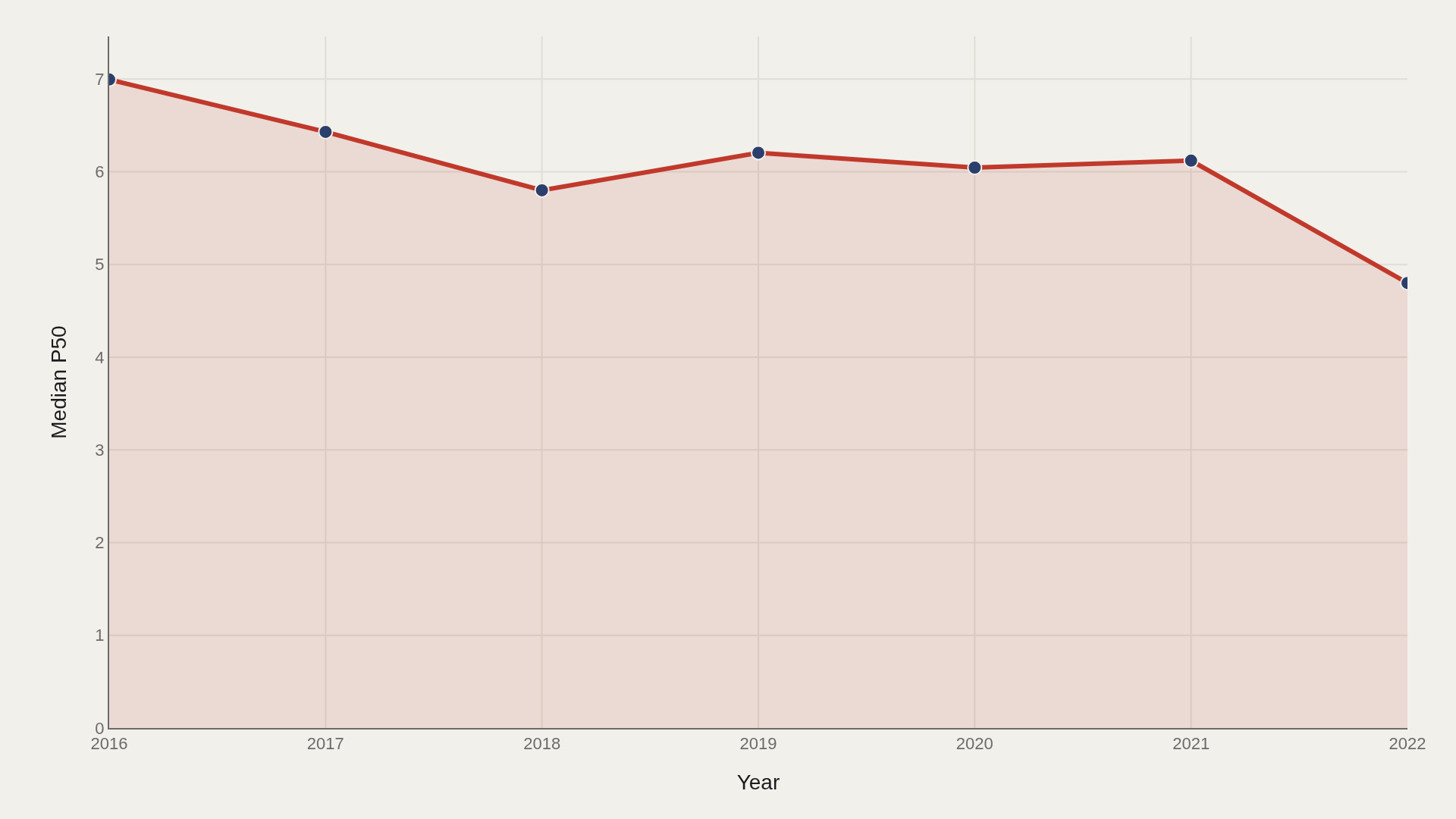
Median p50 is falling from 7.00 in the opening period to 4.80 at the close.
Annual medians filter one-off spikes so the structural slope — not viral outliers — drives the story.
CHART 3 — DISTRIBUTION
Category boxes reveal whether p50 consensus is shared or contested across tiers.
Wide whiskers flag segments where outliers — not averages — drive reputation.
SUPPLEMENT — RELATIONSHIP
Joint plot of p50 and p90 surfaces clusters the averages erase.
Bubble size tracks repeat presence — outliers are archetypes, not noise.
CHART 4 — HEATMAP
Heatmaps expose which client tiers heated up or cooled down across the timeline.
Single-year bars hide drift; the grid shows structural migration between categories.
SUPPLEMENT — TREND
Median p50 moves from 7.00 to 4.80 across the span.
A secondary trend cut confirms whether the headline metric drifts or holds steady.
LIMITATIONS
Community-cleaned TidyTuesday snapshots are not live APIs. Missing values, spelling variants, and week-of-export coverage limits apply. Merged tables may fan out or duplicate rows when join keys are imperfect.
Findings describe the file on hand — treat them as structural signals about Web Page Metrics, not exhaustive truth about the full domain.
CONCLUSION
Read as a teaching map, Web Page Metrics shows why one metric is rarely enough: leaders, tails, trends, and relationships each answer a different question about p50.
The best reading is modest: use the chart to sharpen the question, then check the source and limits before turning it into a claim.
REFERENCES
Data Science Learning Community. (2022). TidyTuesday: Web Page Metrics. https://raw.githubusercontent.com/rfordatascience/tidytuesday/main/data/2022/2022-11-15/speed_index.csv
EDITOR'S NOTE
Artometrics data report from the TidyTuesday research pipeline. Charts and aggregates are reproducible from the embedded exhibits and public source files.